
Eighty-nine years ago today Adolf Hitler inaugurated an ambitious project that entailed reclaiming land from the North Sea to obtain Lebensraum for Aryan families. This new community was called the Adolf Hitler Koog (now Dieksanderkoog, located 62 miles north-west of Hamburg), and the centerpiece was a grand hall. The koog was intended to be a place where the concept of Volksgemeinshaft (people’s community based on racial unity) would be realized, a community that lived up to Nazi ideals of racial purity and unwavering loyalty to NSDAP ideology. Settlers had to produce documentary evidence that proved their Aryan ancestry dating all the way back to 1800, before being personally examined and hand-picked by local senior officials. Hitler himself was present for the official opening ceremonies once the project was completed.

It was shortly after 3 p.m. on 29 August 1935 when the Führer’s motorcade turned into the long street by the dike. Hitler was in the first car. He wore an impressive gray suede trench-coat over his usual uniform to fend off the damp North Sea air. Thousands of outstretched arms reached towards him as he moved along the route towards the Koog. In the nearby town of Marne the crowds had swelled throughout the day and roared “Heil Hitler!” in rapturous ecstasy. Suddenly the sun pierced through heavy clouds and shone brightly as the Führer approached the threshold of the new community. It could not have been planned better to greet his arrival.
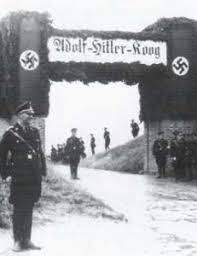
Men of the SS stand at the festively decorated ehrenpforte for the arrival of Adolf Hitler on 29 August 1935.
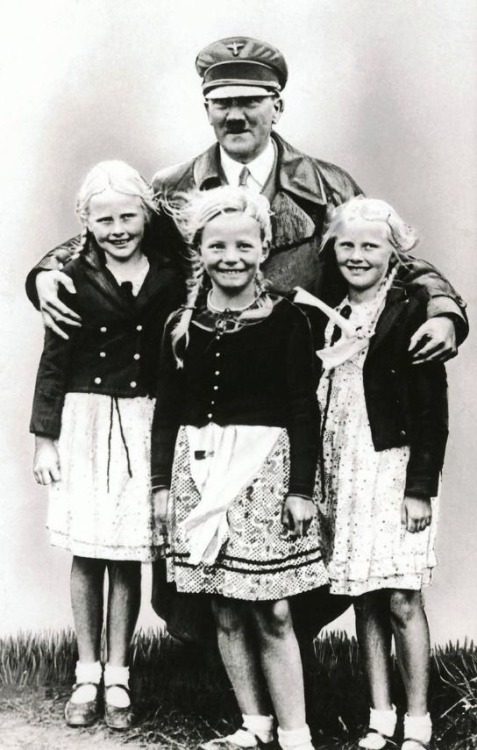
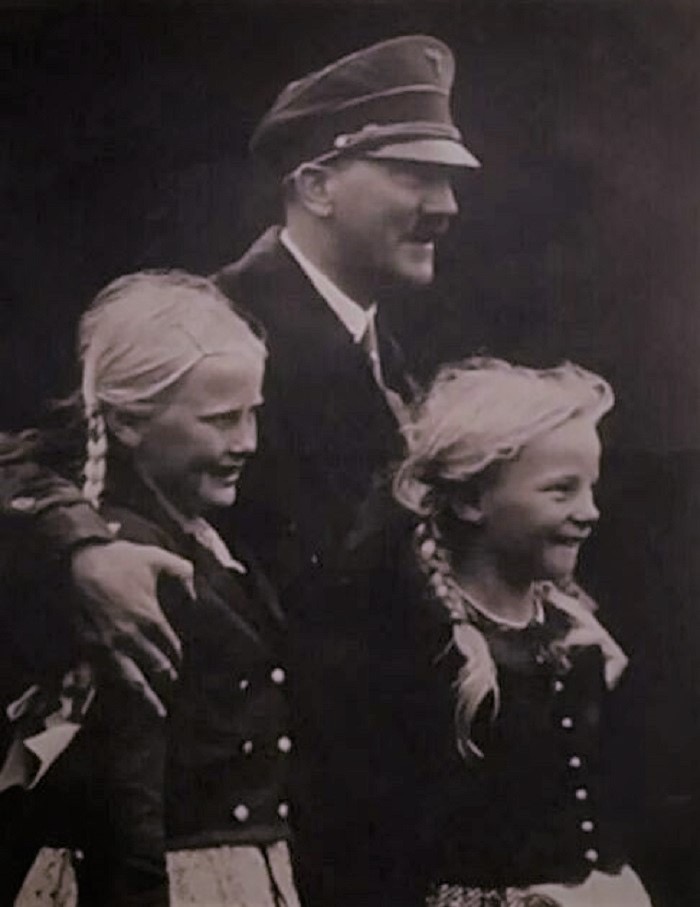
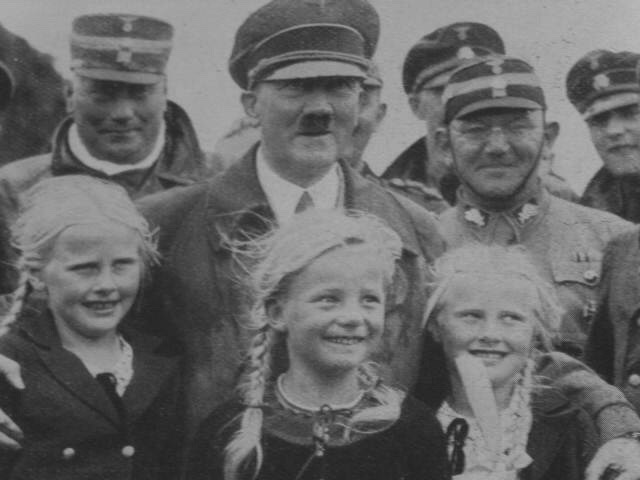
Hitler’s car slowly rolled under the triumphal archway where a banner reading “Adolf Hitler Koog” was written in bold red letters. An SA honor team had taken up positions in front of the gate. Behind the archway the land lay wide open. Not a single tree in sight, just the vast plain and further back the dike, which stood a few meters off the horizon. Swastika flags fluttered on the festival grounds. Three girls with long braids greeted the Reich Chancellor with a curtsy, twin sisters and another girl who had been specially selected from the neighborhood, the blondest of the blondes.

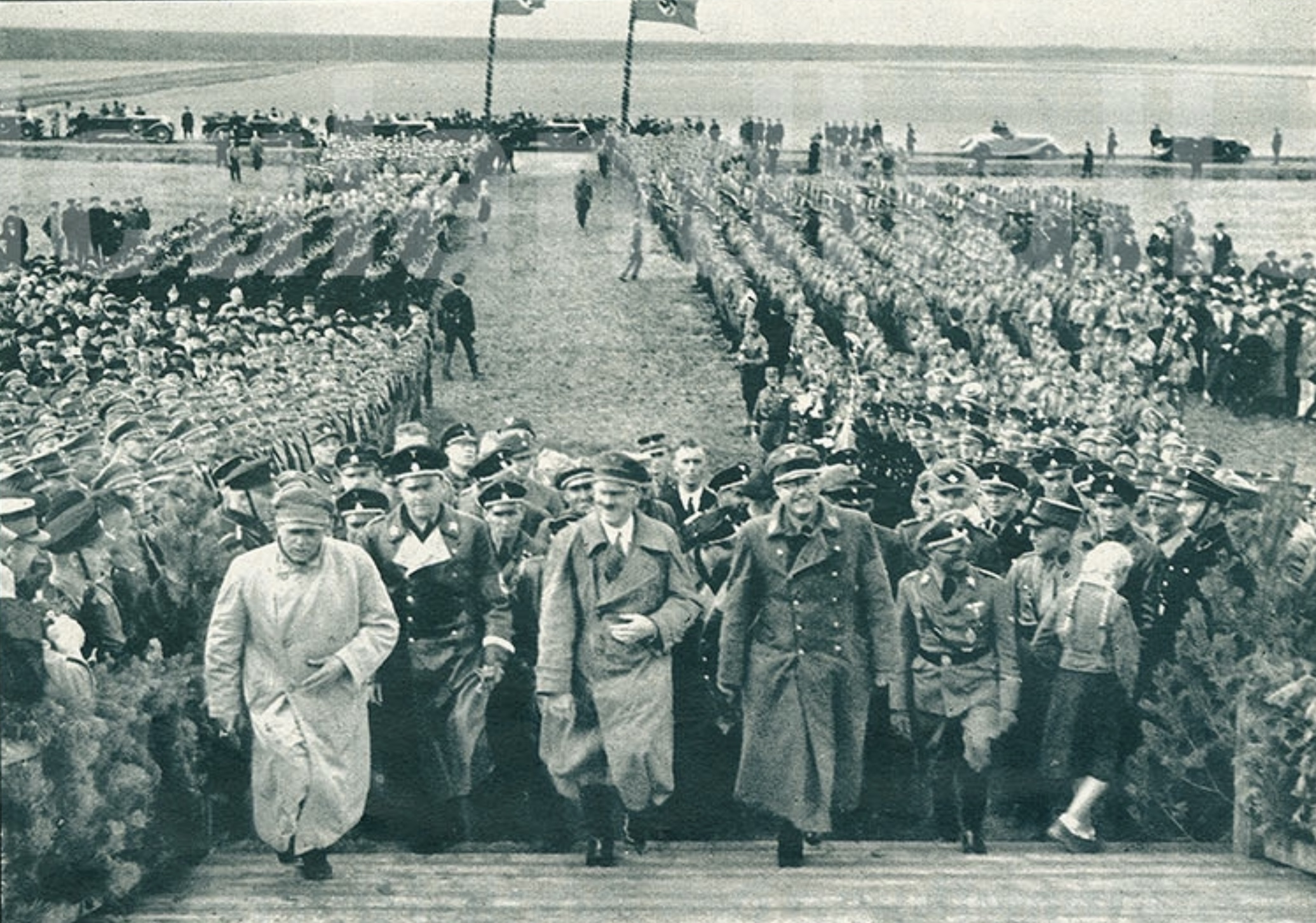
“When we stand on this new land,” Adolf Hitler shouted into the microphone that had been placed in front of him, “we must never forget two things: work alone has created this work. May the German people never forget that at any time life has never been given to people as a gift. Rather, it has always been hard fought for and won through work. And the second realization: Just as every square meter here has to be wrested from the sea and protected with tireless, brave devotion, everything that the entire nation creates and builds must be protected in the same way by all German people.”


The Führer performs the ceremonial three hammer blows at the laying of the foundation stone for the “Neulandhalle” on the “Franzofenfand” in the new Koog, which will also contain a youth hostel.
The farmers stood in front of the stage in their festive best, including Karl-Heinrich Thomsen’s father. The photographers’ cameras captured beaming, proud faces. The mood was exuberant, as the “Hamburger Nachrichten” newspaper later reported. There was a lot to celebrate. Not only that the troops of the Reich Labor Service had reclaimed new land from what was once the seabed, but also that a completely new type of farmer was to be bred on it: Aryan and National Socialist.


Official groundbreaking for the Neulandhalle took place on the “Adolf Hitler Koog” on 29 August 1935, and it was completed by the following August of 1936.
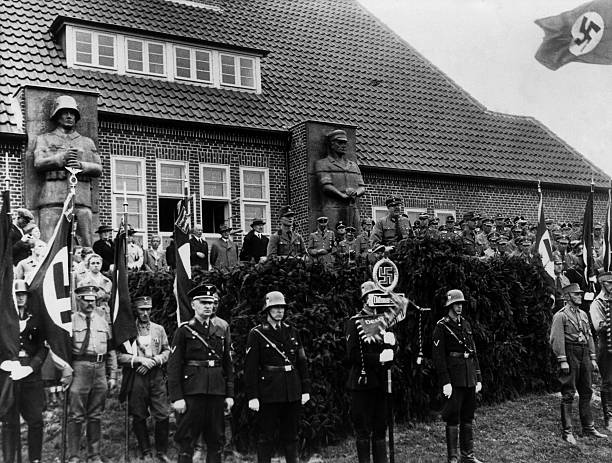
When Adolf Hitler inaugurated the new Koog on 29 August 1935, he also laid the foundation stone for the “Neulandhalle”. Instead of a church, a meeting room for the Koog and a recreational area for the NSDAP branches were built, entirely in keeping with the party’s wishes. Up until the start of the Second World War, the Adolf Hitler Koog had became a popular place of pilgrimage. Up to 40 buses and cars brought visitors to the Koog every day. The propaganda trips had a very positive side effect for the Koog residents. From the very beginning, the Koog had a central water supply, and electricity soon followed. However, the enormous bus traffic made the clay roads almost impassable. After complaints about the constantly rutted farm roads, the roads in the Adolf Hitler Koog were the first in a Koog on the west coast to be asphalted. The construction was co-financed to a large extent by the Reich Propaganda Ministry.


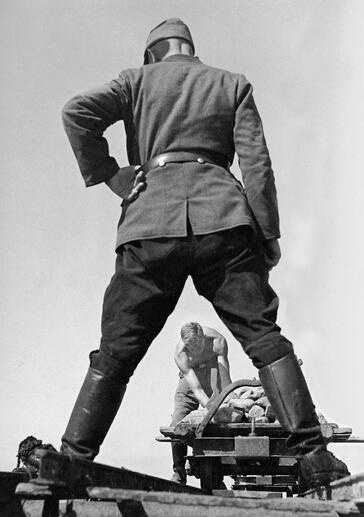
Members of the Reich Labour Service [Reichsarbeitsdienst, RAD] complete their assignment, working on part of the land reclamation and settlement project called ‘Adolf-Hitler-Polder’ [Adolf-Hitler-Koog]. Manual labor was necessary for the construction of the Koog and was desired by employment policy.




Nazi law enforced the principle of blood and soil, aiming to “preserve the farming community as the blood-source of the German people”. Farmers were exhalted in Nazi ideology as a vital source of economic and racial stability.
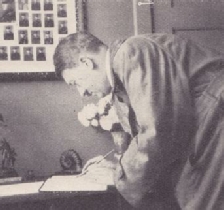
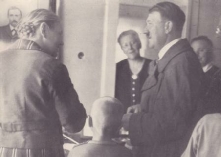
During the festivities on the Hitler-Koog on 29 August 1935 Hitler visited one of the newly constructed homes that were created, and he was the first to sign the official guestbook of the community. Adolf Hitler also visited the house and family of Otto Thiessen, who had been appointed “local farmer leader” (Ortsbauernführer) that same day by Reich Farmers’ Leader Richard Walter Darre.

Adolf Hitler was given a special tribute in the completed Neulandhalle in the “Men’s Room”, which was also referred to as the “Room of Honor”. His bust stood on a bookshelf designed like an altar. It was carved from old half-timbered wood by the Hamburg sculptor Carl Schümann. Extracts from Hitler’s speech delivered at the laying of the cornerstone of the community center framed the sculpture. In front of Hitler’s portrait head sat the Koog book “Des Führers Koog”. On the bookshelves you would find only appropriate ideological literature, such as Hitler’s “Mein Kampf”, as well as books that glorify Dithmarschen’s history.

The Kiel cultural editor Reinhold Stolze described the honorary sculpture of Hitler when it was officially unveiled in 1936:
“The manly facial features, taut with willpower, the thoughtfully concentrated forehead, the speaking, expressively shaped mouth, the large, fascinating, unwavering eyes reveal the energetic leader’s personality in the bust.”
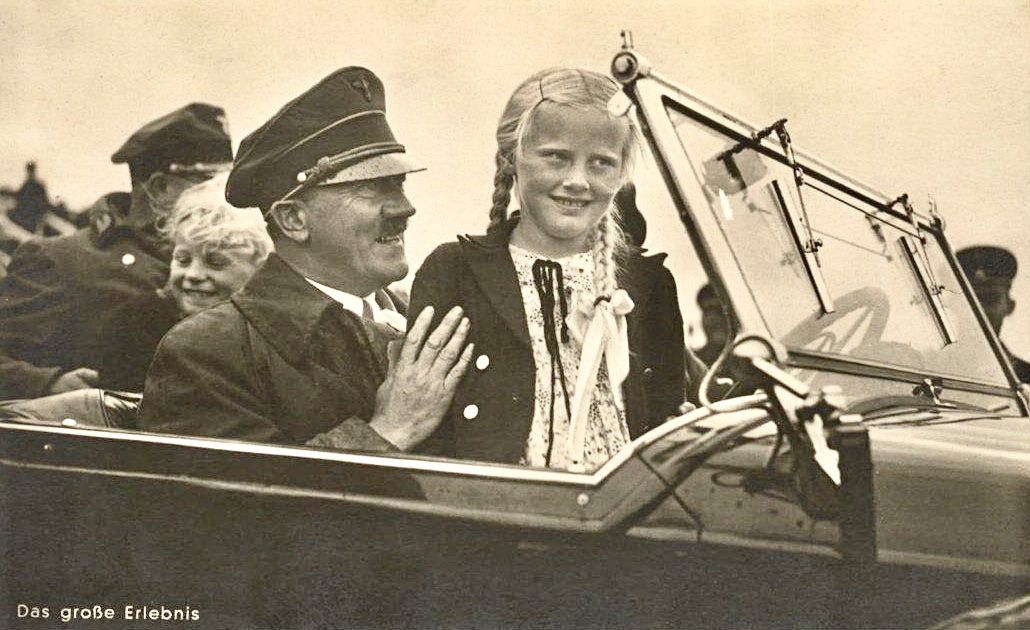
Newspapers and magazines across the country reported on the “consecration” of the Koog by Adolf Hitler. The “Hamburger Illustrierte” published a series of striking photographs with very little text, preferring to tell a picture story: “The Führer hugs three blonde settler girls, drives through the Koog, climbs the festival grandstand, lays the foundation stone of the “Neulandhalle” and finally visits the family of the newly appointed local farmer leader Otto Thießen.”


 Heinrich Hoffmann Photo Gallery