Heinrich Hoffmann (1885 – 1957) served as Adolf Hitler’s official photographer from when Hitler took control of the Nazi party in 1921 until his death in 1945. Hoffmann estimates he took over half a million photographs of Hitler over the course of his career. His portraits were the most significant source of Nazi propaganda materials published over the course of close to 25 years, everything from postcards, posters, magazines, postage stamps and picture books. Click on eachtheme below to see a complete photo albumdevoted to that particular event or topic.
Adolf Hitler ordered the establishment of the Winterhilfswerk (WHW) relief program in 1933 and personally opened the first drive that September, giving out the directive that “no one shall be hungry, no one shall freeze”. The initial donation drive of winter 1933/1934 took place against a backdrop of acute distress in large parts of the German populace; its initiation was partly a result of the party’s desire to prevent social unrest. The “Law on the Winterhilfswerk of the German People”, passed on 1 December 1936, formally established the WHW as a registered association, led by Joseph Goebbels, the Reich Minister of Public Enlightenment and Propaganda.
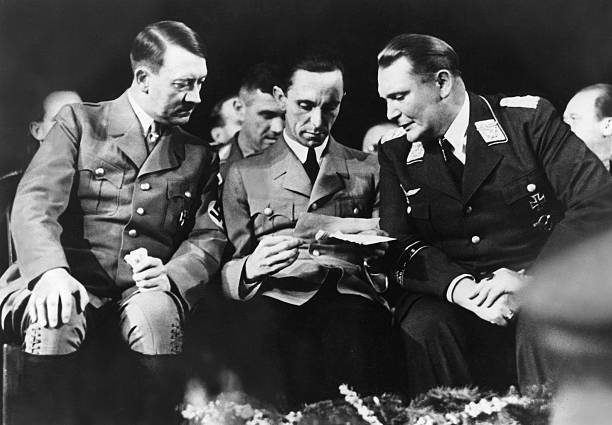
Eröffnung des WHW 1936/1937 in derDeutschlandhalle in Berlin: Joseph Goebbels liest ein Telegramm, in demeine Spende angekündigt wird; links: Adolf Hitler, rechts: Hermann Göring; hinter Goebbels: Hitlers persönlicher Adjutant Fritz Wiedemann on 6 October 1936.
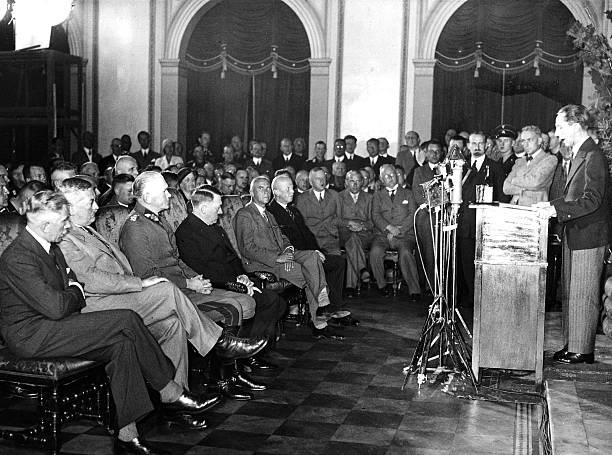
Joseph Goebbels announces the ‘War against poverty and coldness’ in the Ministry of Public Enlightenment and Propaganda on 13 September 1933. Adolf Hitler attends with Franz von Papen, Wilhelm Frick, Max Amann, Franz Xaver Schwarz and Karl Hanke.
“This great campaign against hunger and cold is governed by this principle: We have broken the international solidarity of the proletariat. We want to build the living national solidarity of the German people!”
-Adolf Hitler, 13 September 1933: The Proclamation of the WHW
The Day of National Solidarity
The term “National Solidarity” is attributed to Joseph Goebbels and was used by Adolf Hitler in the inaugural WHW speech delivered on 13 September 1933. On 11 October 1934 Adolf Hitler announced with his opening speech in the Krolloper for the collection of donations at the second “Winterhilfswerk des Deutschen Volkes”. However, Joseph Goebbels, who had highlighted the successful action of the previous year in his diary as “my greatest achievement” soon feared that the donation volume would fall far short of expectations.
At the end of October 1934, he entered in his diary: “WHW is not good. Exert all their might. Large shortfall to be expected”.
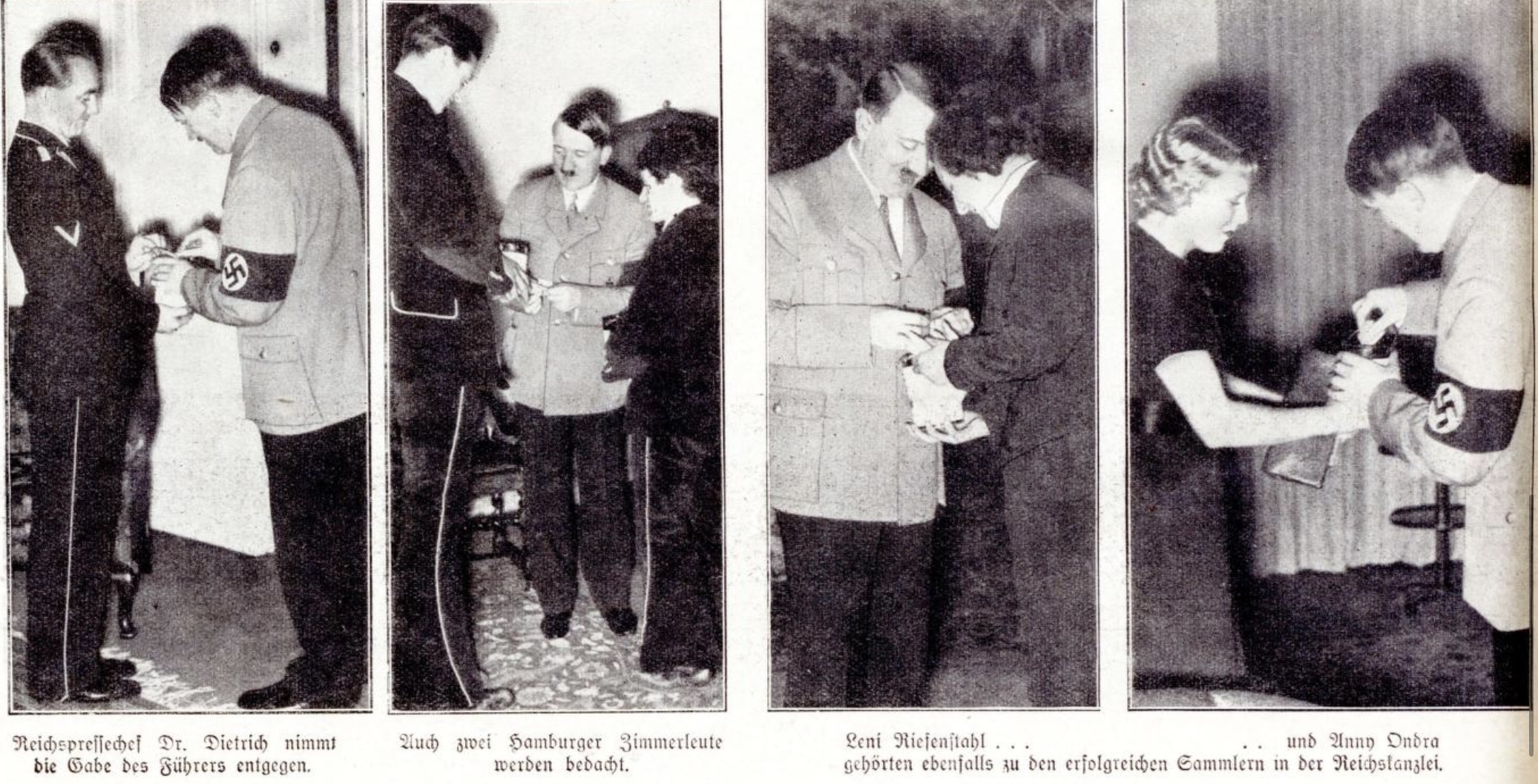
Adolf Hitler and Leni Riefenstahl at the ‘Tag der Nationalen Solidarität’ in Berlin on 5 December 1936.Adolf Hitler donates a 1000-mark note to the Winterhilfswerk to the collection of actress Maria Paudler, in addition to the actress Anny Ondra (wife of German boxing champion Max Schmeling). Leni Riefenstahl was also among the most successful collectors in the Chancellory on the first National Day of Solidarity held on 10 December 1934.
Goebbels wanted to prevent a setback, “strengthen the backs” of the collectors and “popularize” the Winterhilfswerk by including prominent artists and functionaries at the start of the Reich-wide collections. The press, cinema advertisements and posters announced a “Day of National Solidarity”. Goebbels noted on 10 December 1934 of the resounding success of this day, on which, according to initial estimates, 3,500,000 Reichsmark were collected throughout the Reich:
“All in a collector’s mood. The Führer is also very enthusiastic. […] At 4 [o’clock in the afternoon] with Göring at the Adlon. Indescribable. Tens of thousands. An unmistakable jubilation and bustle. I’m almost crushed. […] These wonderful Berliners! And they give. The poorest are the most cordial. Tears often come to me. I collect everywhere. Also Magda [Goebbels]. And thousands of others. Everyone is excited about it. In the evening to the Führer. Report. 30 collectors there. High mood. A great victory. I have 42 cans full.”
Ministerpräsident Göring reports to the Führer on his collecting activities on the first National Day of Solidarity. SS Reichsführer Himmler also appeared to report on 10 December 1934.NSDAP ‘Day of National Solidarity’: Reception for the helpers of the street collection in the Reich Chancellery in Berlin; the actors Karin Hardt, Flockina von Platen and Eugen Klöpfer (from left) with their collection boxes before Hitler on 5 December 1936.
The National Socialists described the Day of National Solidarity as an annually recurring collection day at the start of the “Winter Aid Work of the German People”, in which prominent party officials and artists united for monetary donations with the collection box. As part of the effort to place the community over the individual, totals were not ever reported for any individuals, only what each organization had collectively raised. A 1938 Nazi propaganda leaflet claimed that the Winterhilfswerk had collected nearly a billion Reichsmarks from 1933 to 1937 as well as half a billion in goods and two million kilograms of coal.
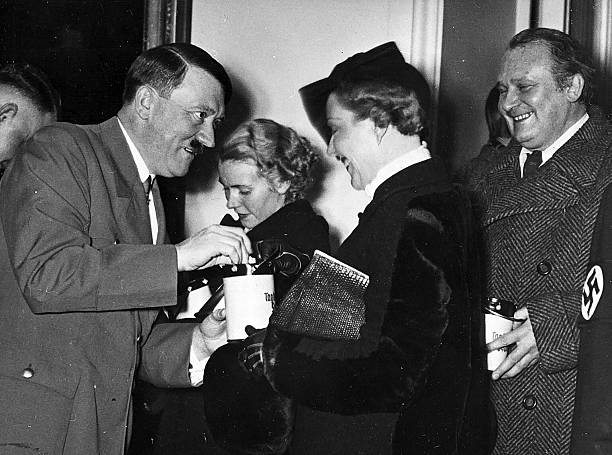
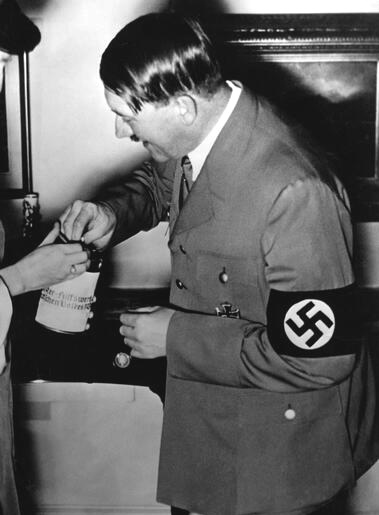
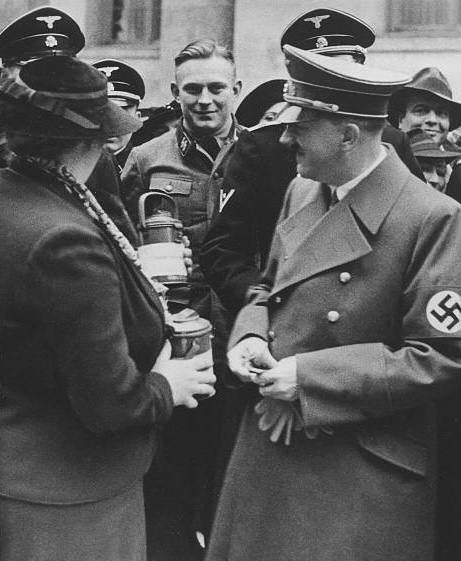
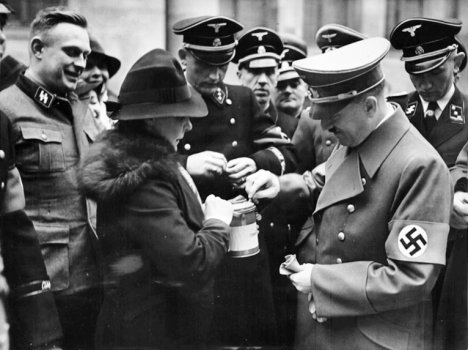
NSDAP ‘Day of National Solidarity’: Adolf Hitler gives Reich stage designer Benno von Arent a donation on 5 December 1936.Adolf Hitler gives a donation for the Winterhilfswerk (WHW) on the ‘Day of, National Solidarity’ on 4 December 1937.Adolf Hitler and Julius Schaub participate in the 1937 Winterhilfswerk by donating into a collection can.Day of National Solidarity. Hitler donates to the Czech actress (and Joseph Goebbels’ beloved) Lída Baarová an unknown amount of money on 4 December 1937.Adolf Hitler donates for the “Winterhilfswerk des Deutschen Volkes” in the Reich Chancellery. 1937.NSDAP ‘Day of National Solidarity’: Adolf Hitler gives a donation to the actor Georg Alexander; right: the personal adjutant SS leader Julius Schaub on 4 December 1937.
The result of the 1937 National Day of Solidarity was enthusiastically praised by the press: “The Winterhilfswerk 1937/38 now proved in its brilliant development the progress of socialist education in the German ethnic community. Thus, the day of national solidarity, 4 December 1937, on which the German Führerkorps again collected in city and country, this time about 8 million RM”.
Meeting of participants of the Berlin Winter Relief in the Reichskanzlei in Berlin: Hitler greets Joseph Goebbels, in the background Erich Hilgenfeldt – 27.05.1936
The actor Willy Fritsch collects donations for the Winter Relief with a collecting box on the ‘Day of National Solidarity’ on 3 December 1938. Here he takes a donation from the Reich Chancellor Adolf Hitler.
Walter Tausk, writer and author of the Breslauer Tagebuch 1933-1940, who was classified as a Jew by the National Socialists, wrote on the 3 December 1938 in his diary: “Today is the ‘Day of German Solidarity’, as can be seen from the attachment that was in our mailbox yesterday. The Jews are therefore under house arrest from twelve to eight o’clock […], which means they are not allowed to leave their homes, since they are not involved in German solidarity.’ That is not so bad. As long as you are left alone.”
Adolf Hitler and Magda Goebbels donating money on the day of national solidarity on 3 December 1938.Adolf Hitler gives a donation to the ‘National Day of Solidarity’ to actor Heinrich George, who has appeared in the costume of Goetz von Berlichingen at the Reich Chancellery in Berlin on 3 December 1938. Heinrich George was one of the greatest actors in German theater and film history. His performances as “Götz von Berlichingen”, “The Postmaster” and “Franz Biberkopf” are legendary.NSDAP ‘Day of National Solidarity’: a donation for the actors Hans Brausewetter and Paul Dahlke (from left); far right: the personal adjutant Albert Bormann, brigade leader of the NS-Kraftfahrerkorps (NSKK) on 3 December 1938.Adolf Hitler donates to the Winterhilfswerk (WHW) on 12 February 1939 – Published by: ‘Berliner Morgenpost’ 13.02.1939.Adolf Hitler in conversation with collectors for the Winterhilfswerk (WHW) on the occasion of a community stew dinner in the honorary courtyard of the new Reich Chancellery in Berlin on 12 February 1939.Adolf Hitler makes a contribution to the Party’s Winter Relief charity in the Court of Honour at the Reich Chancellery on 12 January 1939.
Charity Concerts and Events
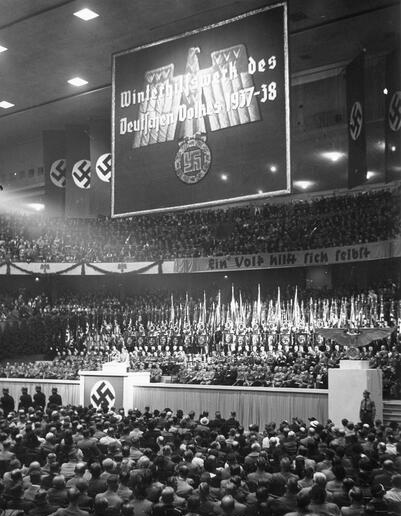
Adolf Hitler at a concert for the Winter Relief in Berlin on 1 February 1935. Concert of the Nazi Cultural Community with the Leipzig Gewandhaus Orchestra at the Berlin Philharmonic for the Winter Relief. From left: the Munich Gauleiter Adolf Wagner, SA-Group Leader Wilhelm Brueckner, Adolf Hitler, Reich Leader Alfred Rosenberg, adjutant Fritz Wiedemann and Reich Leader Philip Bouhler.Adolf Hitler at a concert of the Leipzig Gewandhaus Orchestra on 1 February 1935 in the Philharmonie in Berlin. The NS-Kulturgemeide, an organization established in 1934, evolved from Alfred Rosenberg’s Kampfbund der Deutschen Kultur founded in 1929 to oversee cultural education and the arts.The inauguration of the Great Winter Relief Fund for the German people 1935-36 the Führer gives a speech at the Kroll Opera House on 8 October.
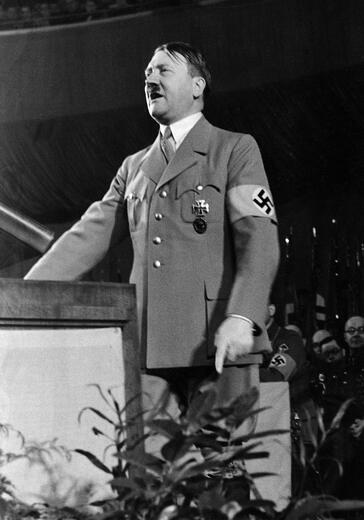
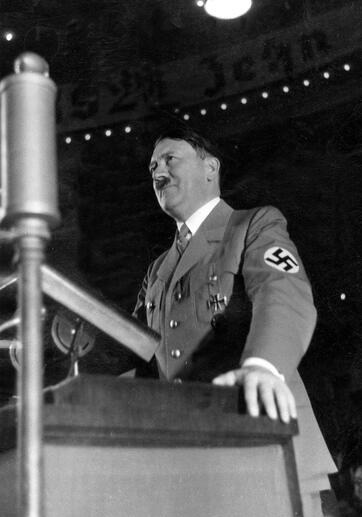
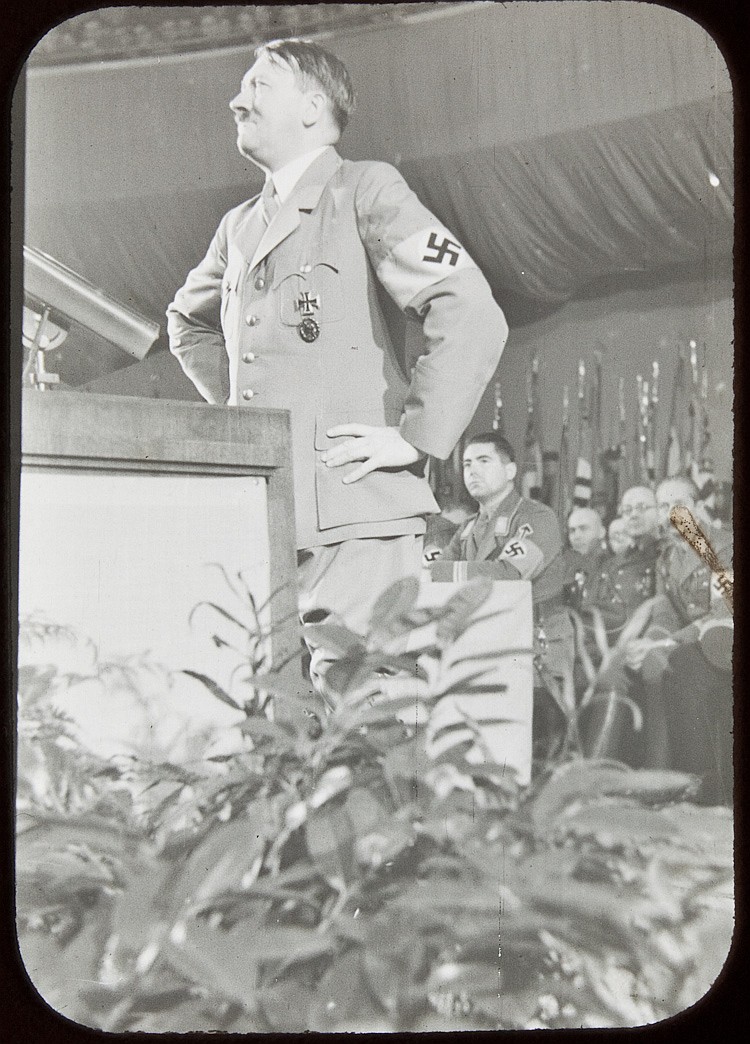
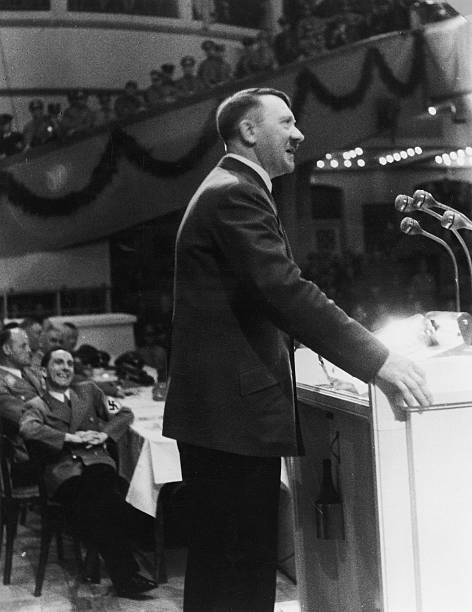
Adolf Hitler speaks at the opening of the Winter Relief Program.
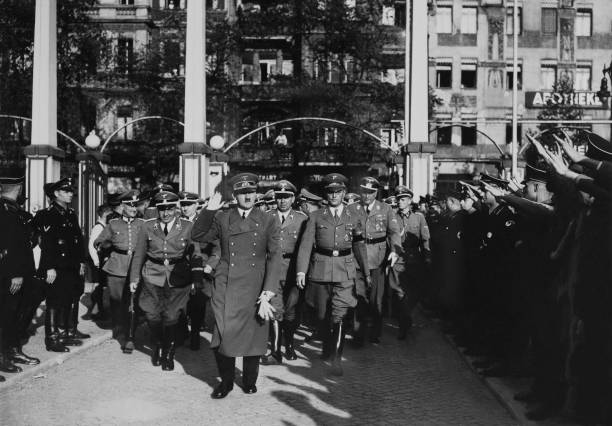
Adolf Hitler, 1936. Adolf Hitler speaks at the opening of the Winter Relief Program.Adolf Hitler saluting Fraulein Irmgard Georgius on her horse Furstin in the Deutschland halle at a horse show in aid of the Winter Relief Fund on 2 February 1936Adolf Hitler greets Germany’s best woman equestrian competitor of the 1930s, Irmgard Georgius, on 2 February 1936 at a riding tournament in Berlin.Adolf Hitler attending a concert in the Deutschlandhalle, Berlin, organized by the SS and the Hitler Youth in aid of the Winter Relief (a program of the national welfare organization in Nazi Germany); from the l: Reich Youth Leader Baldur von Schirach, A.H., Commander-in-Chief Werner von Fritsch, and the Third Reich’s Press Chief Dr. Otto Dietrich; 2nd row, far left: Hitler’s personal adjutant Fritz Wiedemann on 16 December 1936.Nazi Leadership At Benefit Concert Left to right: Emmy Goering, Adolf Hitler, Joseph Goebbels and Hermann Goering at a benefit concert by the Berlin Philharmonic orchestra for the Winterhilfswerk (WHW) Nazi social welfare organization at the Berliner Philharmonie concert hall in Berlin on 10 February 1937. The orchestra is conducted by Wilhelm Furtwängler. Opening by the Führer of the Winter Help Works in Germany on 4 September 1940.Opening of the Winter Relief 1940 / 1941 at the Sportpalast in Berlin: Adolf Hitler delivering a speech; next to the lectern on the left: Joseph Goebbels and the commissioner for the ‘Winterhilfswerk’ (WHW) Erich Hilgenfeldt – 04.09.1940 – Photographer: Presse-Illustrationen Heinrich Hoffmann Adolf Hitler at a major event in the Sportpalast in Berlin on the occasion of the opening of the Winterhilfswerk on 30 September 1942.
Various groups, including the Hitler Youth, went door to door soliciting donations from the public, and in return they would receive the latest lapel badge or booklet. At times the badge designs would change as often as weekly so that the public were pressured into contributing money frequently by having the latest badge. By 1945 over 8000 different badges had been produced, in a variety of material and techniques including wood, glass, paper, metal, plastic, leather and amber. People who were not wearing the latest lapel badge had their names put in the paper to remind them of their neglect. Community pressure ensured constant giving from the German people.
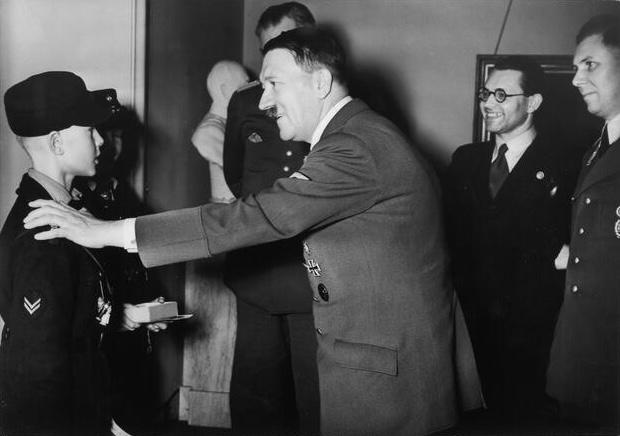
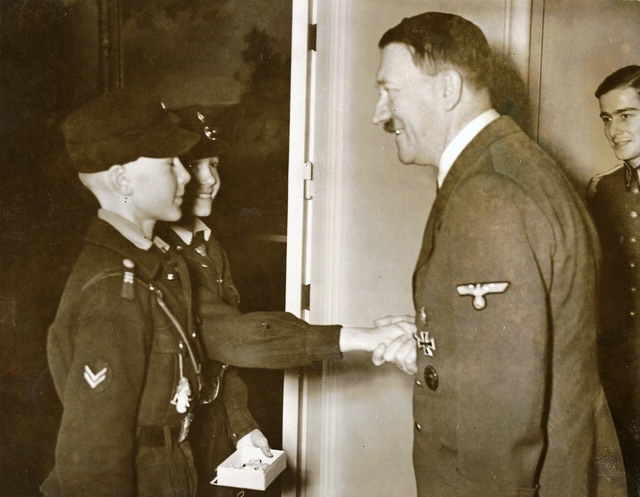
Boys and girls of the Hitler Youth receive a charitable contribution to the Nazi Party’s Winter Relief charity from Nazi leader Adolf Hitler in 1936.Two lucky young boys are chosen to collect for the Third Reich’s winter relief fund for the German people. Hitler greets the boys with Bouhler and Bormann.‘Pimpfe’ of the Hitler Youth collect a donation for the ‘Winterhilfswerk’ (Winter Relief Work) from Adolf Hitler at the Reich Chancellery in Berlin.
Truck of the NSKK collecting donations for the winter relief (WHW) at the first ‘Eintopfsonntag’ 1936 / 1937, every first sunday of the month people were asked to eat only stew and donate the money they saved for their usual sunday meal to the winter relief – Published by: ‘Das 12 Uhr Blatt’ 02.11.1936
Men of the National Socialist Motor Corps (NSKK) driving miniature cars carrying banners to publicize the Nazi Party’s Winter Relief charity in Hamburg in 1937.
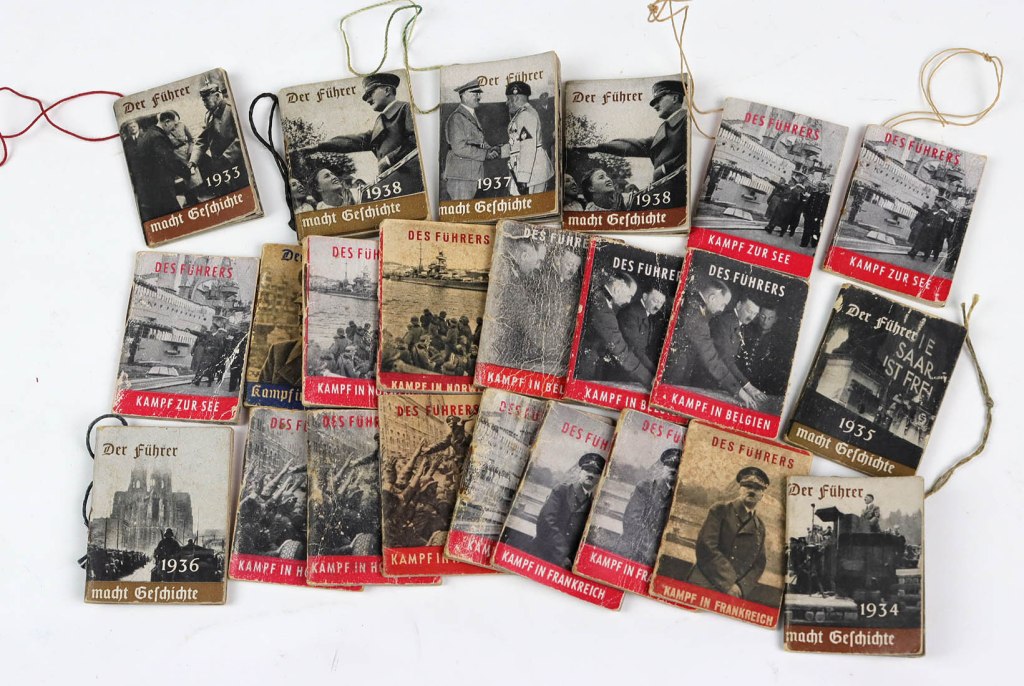
Tiny books with photographs of the Führer’s accomplishments were sold to raise funds to support various charities. In Nazi Germany the Winterhilfswerk (Winter Charity Campaign, or WHW) collection campaigns took place each Winter and raised a great deal of money for charity such as the German Red Cross. This series of booklets were published from 1937 -1941 by Heinrich Hoffmann, Hitler’s official photographer. There were 26 different books in total to collect. The booklets had a string, so one could wear them from a lapel pin, to show that you had made a donation. The following week, when there was a new series of badges & tokens to collect, the booklets could then be hung elsewhere in the home, such as from the Christmas Tree along with other Reich approved ornaments.
I love history and have always been infatuated with the design and style of the 1920’s. Unfortunately I can’t time travel back to this era, so I live vicariously through books, movies and photos.
Another fabulous article, full of information and photos I’ve never seen before! I didn’t know anything about this subject, so every single picture and text was very interesting and informative!
[…] one-pot meals. The money saved eating these inexpensive stews was to then be donated to the Winterhilfswerk annual charity drive. Adolf Hitler warming up by the kachelofen in the living room at Haus […]
[…] originally established in 1931 as a small Nazi Party-affiliated charity, inaugurated the very first Winter Relief of the German People (Winterhilfswerk). The Winterhilfswerk became an annual drive to collect charity for the poor in order to provide […]


















 Heinrich Hoffmann Photo Gallery