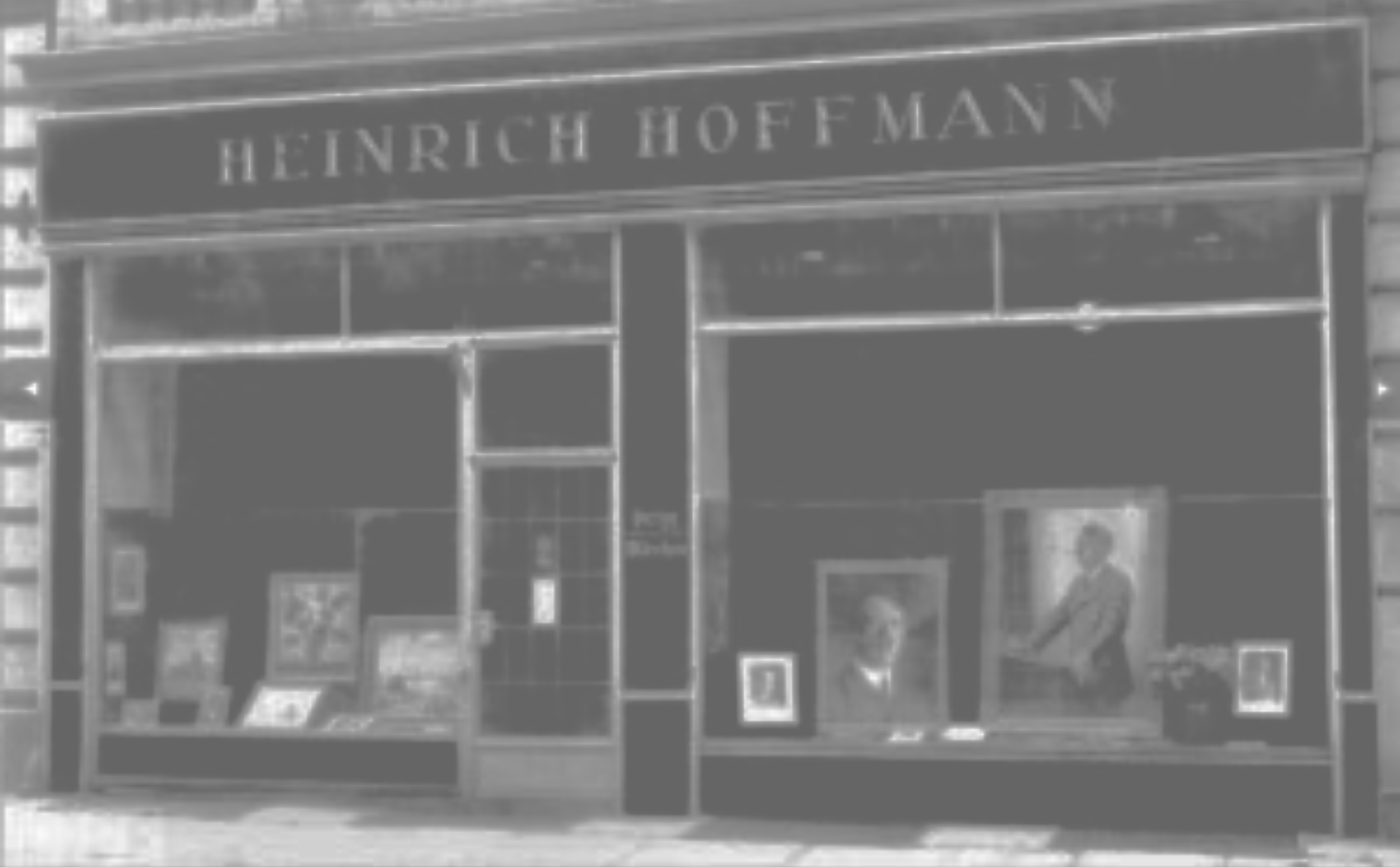
Heinrich Hoffmann (1885 – 1957) served as Adolf Hitler’s official photographer from when Hitler took control of the Nazi party in 1921 until his death in 1945. Hoffmann estimates he took over half a million photographs of Hitler over the course of his career. His portraits were the most significant source of Nazi propaganda materials published over the course of close to 25 years, everything from postcards, posters, magazines, postage stamps and picture books. Click on eachtheme below to see a complete photo albumdevoted to that particular event or topic.
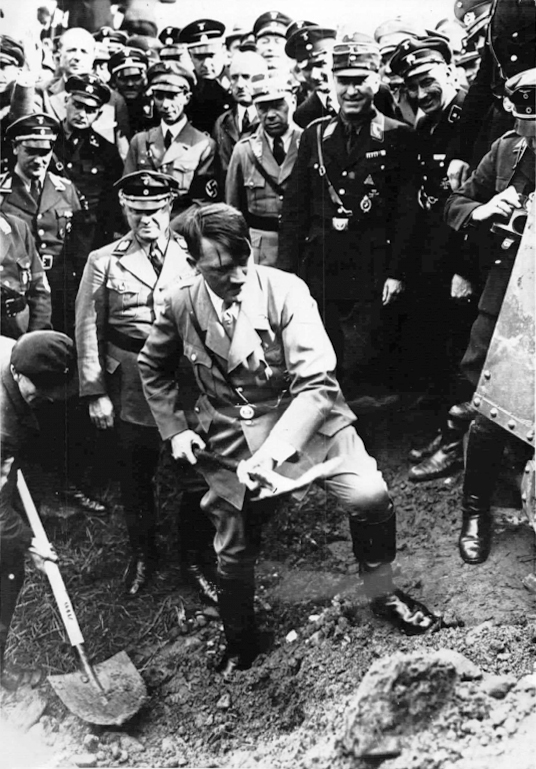
It was 90 years ago today that Adolf Hitler himself picked up a shovel and broke ground for the construction of the Reichsautobahn highway system on 23 September 1933. By the end of the following year construction had begun in eleven major corridors across Germany. When Hitler came to power in 1933, he wanted to show that his government could get things done in a way that the previous Weimar government could not, and building the Autobahn was seen as the perfect symbol of the progress, employment, and prosperity promised by the Nazi regime. Picking up a spade and telling the crowd to “get to work”, all subsequent propaganda referred to the project as the “roads of the Führer” as a way of connecting highway construction to his effective leadership.
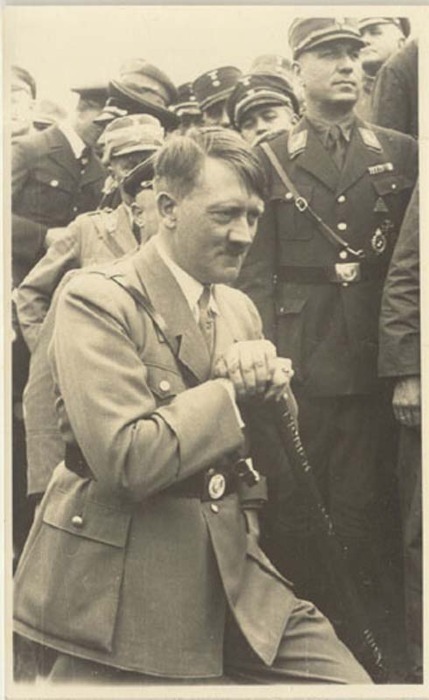
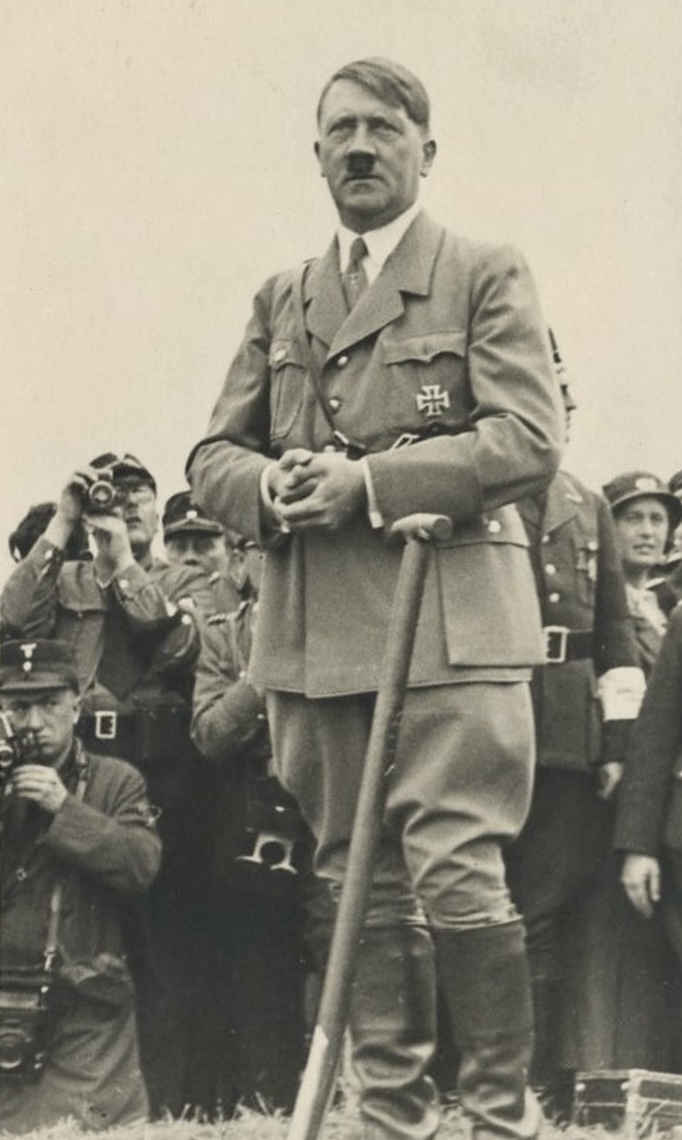
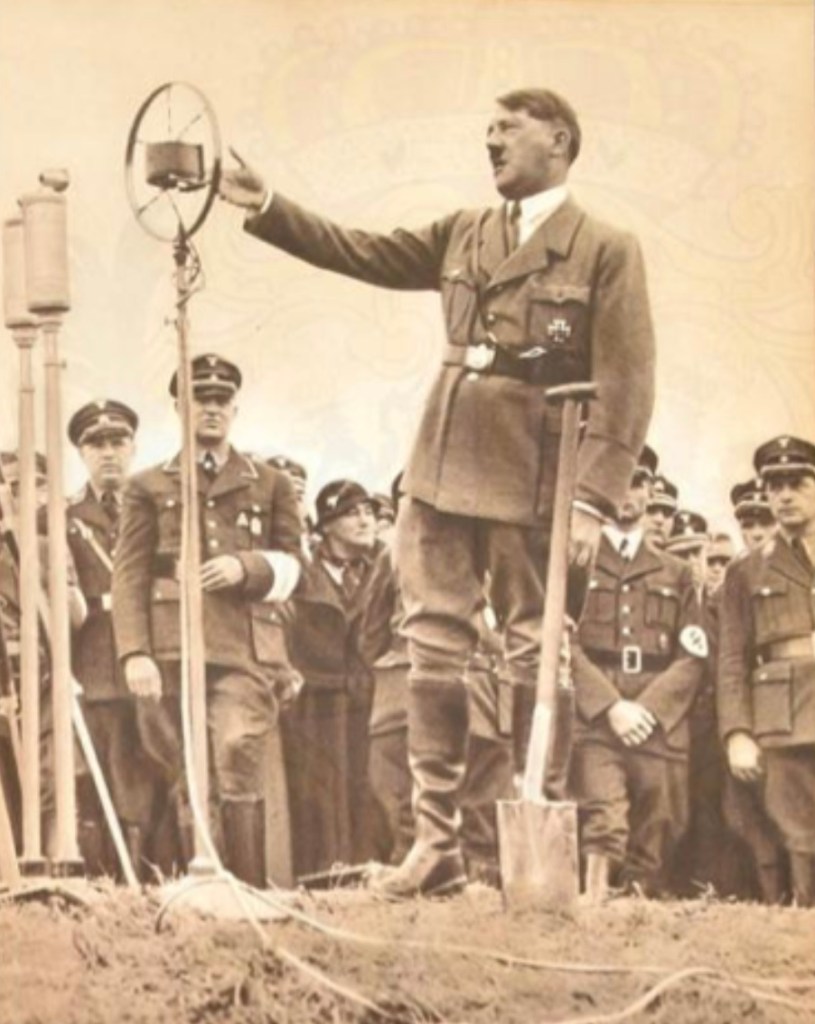
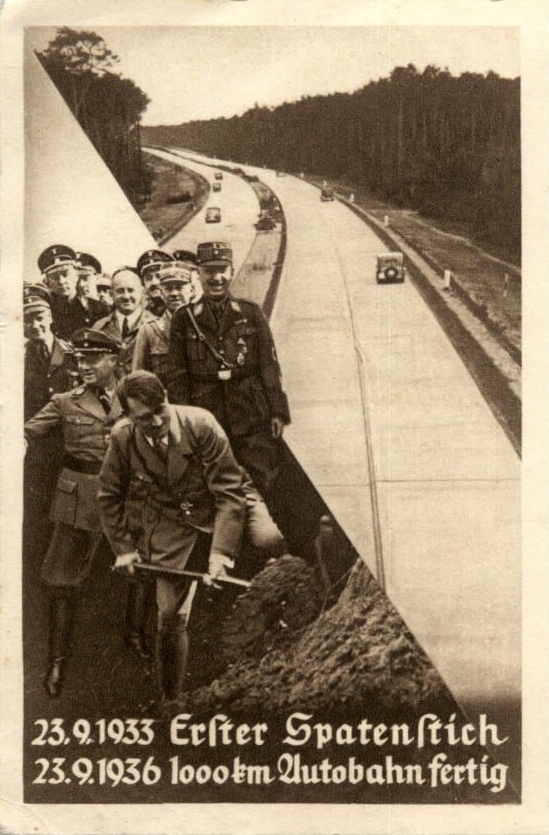
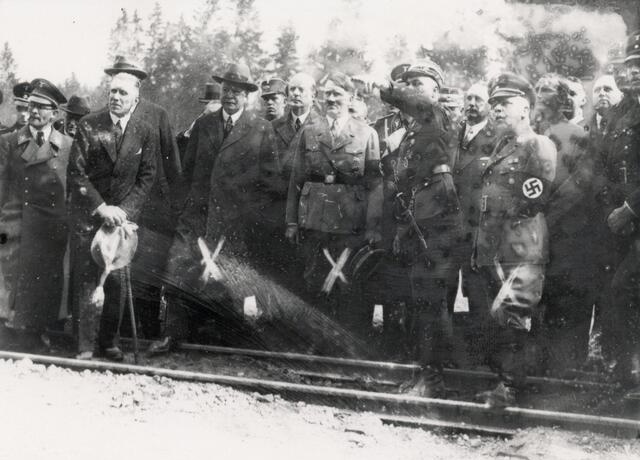
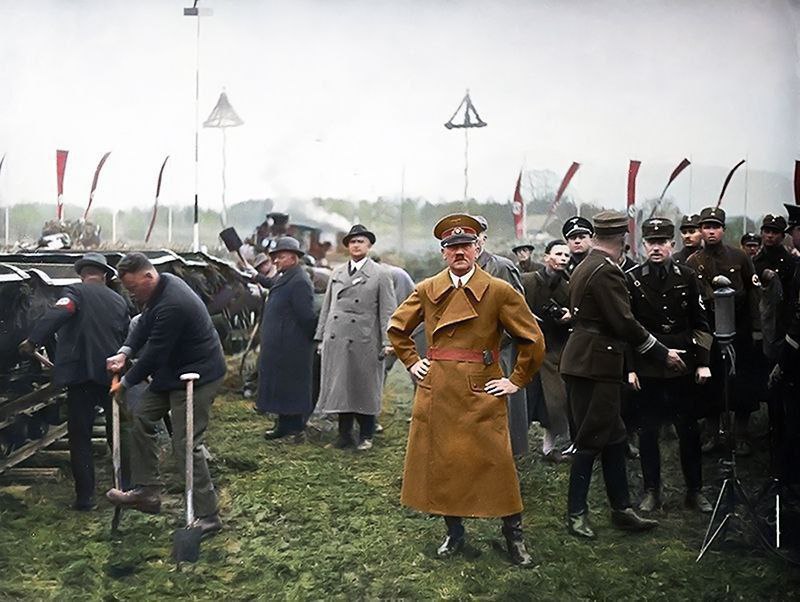
Hitler beim ersten Spatenstich für die Reichsautobahn Frankfurt/Main Heidelberg 23..9.1933. Adolf Hitler wields a spade at the groundbreaking ceremony for construction of the first section of the autobahn from Frankfurt am Main to Darmstadt on 23 September 1933 in Frankfurt.
Contrary to a common misconception held to this day, the Autobahn was not a Nazi invention. The motorway system was indeed presented to the German public as Hitler’s idea, having claimed that he had sketched out the future network of highways while serving his sentence in Landsberg Prison in 1924. But the first plans for a German motorway date back to before the First World War. The mayor of Cologne, Konrad Adenauer, was responsible for the construction of a motorway between Bonn and Cologne that opened in 1932. The term “Autobahn” was even coined by Robert Otzen in 1927, and derives from the name of the most popular transport means in Germany up to this point which was the railway, or ‘Eisenbahn’ in German.
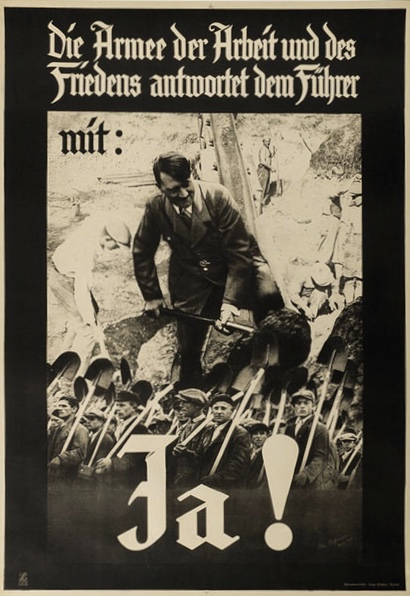
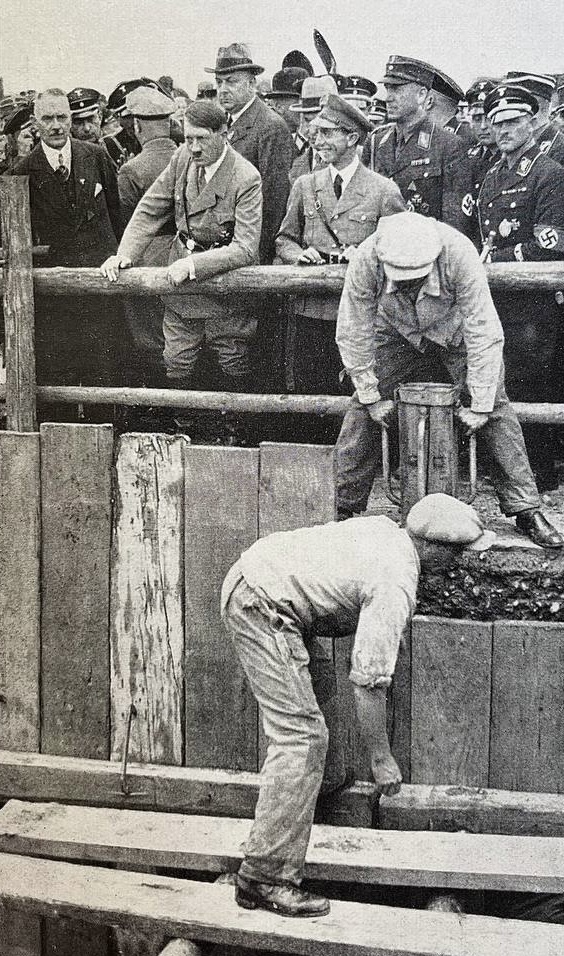
These photos of Hitler wielding a shovel were used many times in Hoffmann’s propaganda materials, including being superimposed on the workers’ march in a poster urging Germans to ratify the Nazi government in the November 1933 parliamentary election.
“The army of labor and of peace answers the Führer with: Yes!” This Hoffmann propaganda poster urges Germans to repay Hitler for creating jobs by voting “yes” in the 12 November 1933 public referendum on German foreign policy.
On 23 September 1933, the first 720 unemployed marched to the Frankfurt Stock Exchange where they were ceremonially invested with shovels as Reichsautobahn workers. Accompanied by SA men, they then marched behind Fritz Todt and Jakob Sprenger, the Reichsstatthalter of Hesse, down to the bank of the Main. Following another ceremonial speech, Hitler inaugurated the work on the autobahn system with the first ceremonial shoveling of dirt to form the base of an embankment.
Dr. Todt described the scene in an illustrated album published by Hoffmann in 1935, “again and again his shovel plunged into the mound [of dirt]. This was no symbolic shoveling; this was real construction work!” Two of the workers “sprang … to help him”, and they worked “until the mound had been dealt with in an orderly fashion and … the first drops of sweat were dripping from his brow onto the earth.”
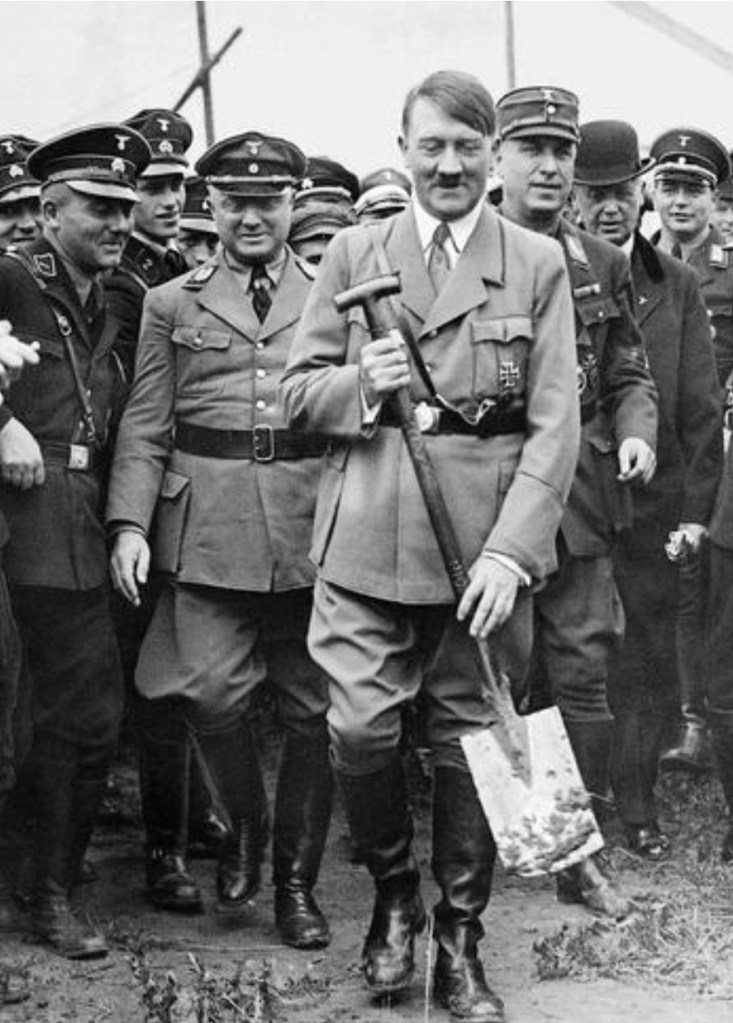
Standing directly behind Hitler at the Reichsautobahn groundbreaking ceremony is Jakob Sprenger, Gauleiter of Hessen-Nassau. This location in Frankfurt was later marked with a park and a commemorative stone.Hoffmann Postcard: Der erste Spatenstich der Reichs-Autobahn “The first groundbreaking ceremony for the Reichs-Autobahn”
These motorways were to be “the Führer’s roads”, a myth promoted by Todt himself, who coined the phrase and warned close associates not to “in any way [let] the impression arise that I built the autobahns. They are to be reckoned as simply and solely the Führer’s roads.”
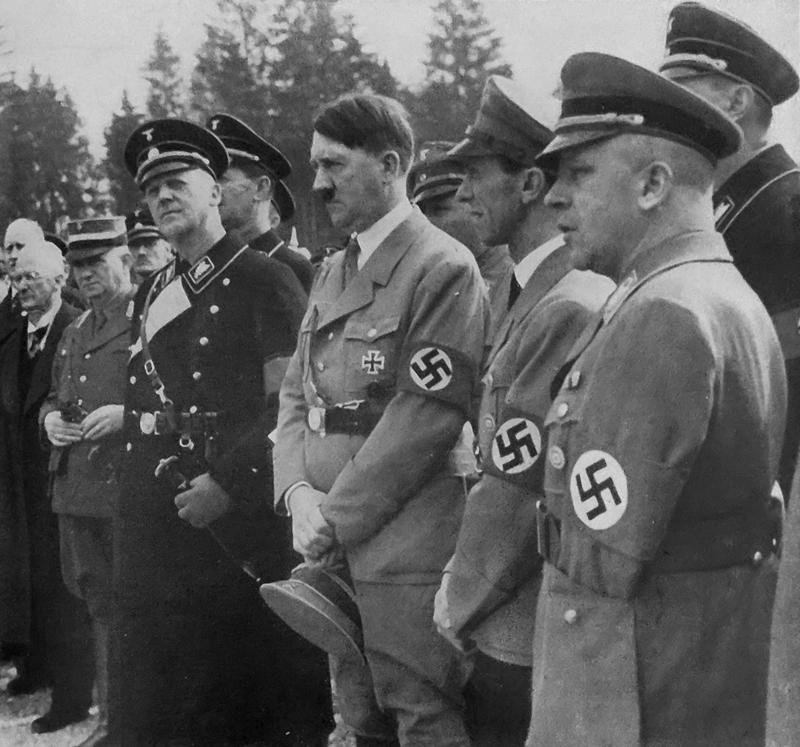
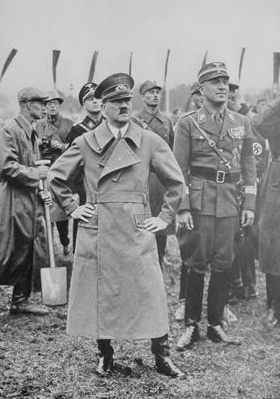
Hoffmann postcard showing Hitler and Todt at the Reichsautobahn groundbreaking ceremony on 23 September 1933.Another shot showing Adolf Hitler at the Reichsautobahn groundbreaking ceremony on 23 September 1933. Notice he is not wearing his swastika armband on his uniform at this event!
Hitler’s goal was to complete 1000 kilometers of the autobahn every year, and he promised that this would drastically reduce the high unemployment rate. Autobahn construction was intended to create at least 600,000 jobs, but there were never more than 120,000 people at work at any given time on the project. The construction was marred by sickness, hunger, forced labor, death, and strikes, with the strike leaders sent to concentration camps. By 1941, only 3,800 kilometers of autobahn had been completed, less than half the projected amount to be constructed by this time.
The Autobahn was a technological marvel for its time. No other country had attempted to construct anything like it, although there was little need to given the availability and capability of cars in the 1930’s. That didn’t stop Hitler from taking on the project as the perfect symbol to represent National Socialist progress.
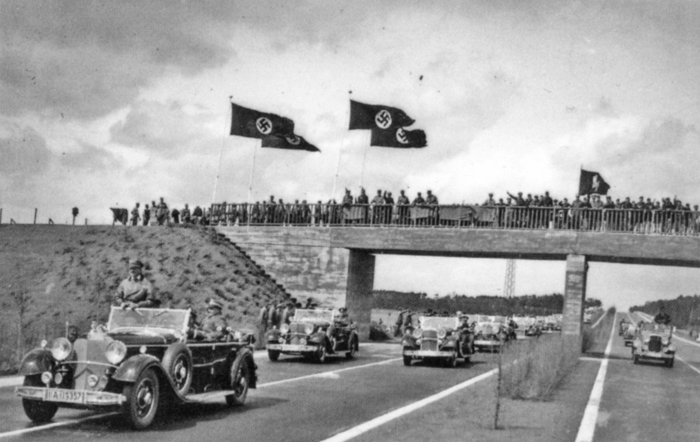
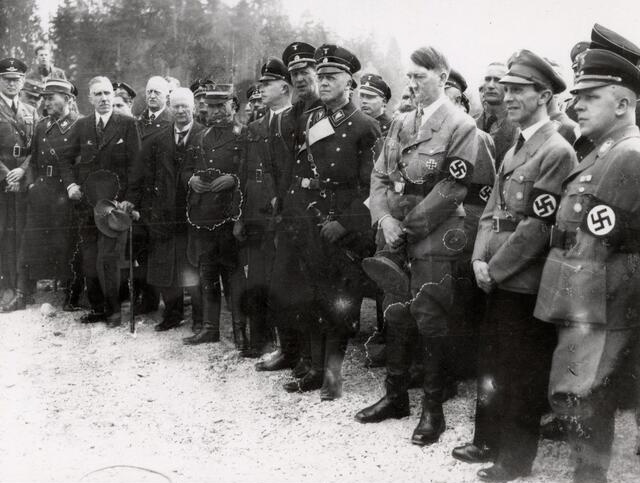
Adolf Hitler makes the groundbreaking ceremony for the construction of the Frankfurt-Heidelberg motorway line on the Schwanheimer Ufer (later bridge of the A 5 over the Main) before traveling to Hannover-Vahrenwald and delivering a speech in the Stadthalle at the Reichsführertagung des Stahlhelms in front of 55,000 listeners. Adolf Hitler in his Mercedes inaugurates the new 14 km stretch of Autobahn between Frankfurt and Darmstadt on 19 May 1935.Adolf Hitler at the opening of the Reichsautobahn Frankfurt-Darmstadt on 19 May 1935. With the opening of the short section of the Frankfurt-Darmstadt motorway, the construction of which began with great Nazi propaganda on 23 September 1933, the first section of a motorway in the Reich built under the Nazi government was opened to traffic. The section from Darmstadt to Heidelberg followed on 3 October 1935.Adolf Hitler greeting and joking with local women at the inauguration of Germany’s first highway linking Frankfurt to Darmstadt on 19 May 1935.Cigarette card from ‘Adolf Hitler: Bilder Aus Dem Leben Des Führers’ showing Hitler with government officials and military officers at the opening of the Reich’s autobahn in Frankfurt-Darmstadt on 19 May 1935; note cameras on stands in the background. Official Caption: “Sammelwerk Nr. 15, Bild Nr. 124, Gruppe 64. Reichsautobahn-Erffnung Frankfurt-Darmstadt 1935. [Opening of the Reich’s autobahn in Frankfurt-Darmstadt 1935.]”
Adolf Hitler began the second Arbeitsschlacht (labor battle) at the Unterhaching Reichsautobahn construction site near Munich in front of around 10,000 people on 21 March 1934. The Frühjahrsarbeitsschlacht (Spring Labor Battle) opened with an impressively staged prelude to the construction of the Munich-Salzburg motorway, which launched simultaneously at 22 different construction sites along the route of the planned highway. Hitler’s National Socialist government achieved enormous progress in the reduction of unemployment through these Nazi Work-Creation Programs of 1933 and 1934. During his first year in power, Hitler reduced unemployment by one-third, and within eighteen months unemployment had been cut by sixty percent. However, the promise given in Hitler’s speech of attaining 100% employment across Germany was never actually achieved.
Adolf Hitler announces the new job creation program at the construction site of the new Munich state border motorway in Unterhaching near Munich on 21 March 1934.Rare photo showing Dr. Joseph Goebbels together with Adolf Hitler overseeing construction on the autobahn in Unterhaching. Featured in the book “Signals of the New Age” (1934) by Dr. Goebbels.Picture No. 63 from the cigarette card series “Männer und Ereignisse unserer Zeit” (Men and Events of our Time) “The Führer opens the second major industrial battle on March 21, 1934 in Unterhachingen near Munich” This album of cigarette cards show Nazi party officials and events in Germany between May 1933 and June 1934.Adolf Hitler, Joseph Goebbels, and Max Amann during Fritz Todt’s speech at the 8.3 kilometer of the construction of the Reichsbahn between Munich and Salzburg on 21 March 1934.Adolf Hitler at the opening of construction work on the Reichsautobahn München-Salzburg. Speech at the construction site of the Reichsautobahn Munich-Salzburg on 21 March 1934.Adolf Hitler greets workers at the construction site of the new Munich state border motorway in Unterhaching near Munich on 21 March 1934.Adolf Hitler, accompanied by Dr. Fritz Todt (right), the German Road and Transport Inspector, watches work in progress on the world’s largest concrete bridge over the Inn River near Munich on 4 December 1934. The completed bridge had a length of 845 feet.
Adolf Hitler personally acknowledged and greeted the construction workers who were building the ‘Autobahn’ (motorway) during a parade of the German Labour Front at the Nuremberg Rally on 11 September 1937. Fritz Todt, the General Inspector of German Roadways and founder of the so-called ‘Organisation Todt’ (A Third Reich civil and military engineering group responsible for the construction of the ‘Autobahn’ network), and the head of the German Labour Front, Robert Ley, were also in attendance.
The Berlin Motor Show
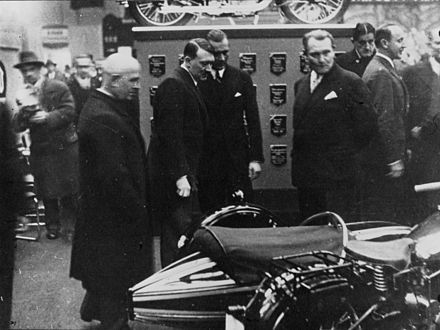
Adolf Hitler delivers a speech at the inauguration of the Berlin Motor Show automobile exhibition on 11 February 1933 in Berlin, Germany.
One of Hitler’s first public speeches as chancellor was given at the Berlin Motor Show to promote the German automobile industry and the building of the Reichsautobahn. By slashing taxes and regulations on Germany’s automotive industry, to align its growth and development with aviation, to build a nationwide highway system, and to dominate international motorsport. “These momentous tasks are also part of the program for the reconstruction of the German economy!” With these words the new chancellor declared the 1933 International Motor Show open.
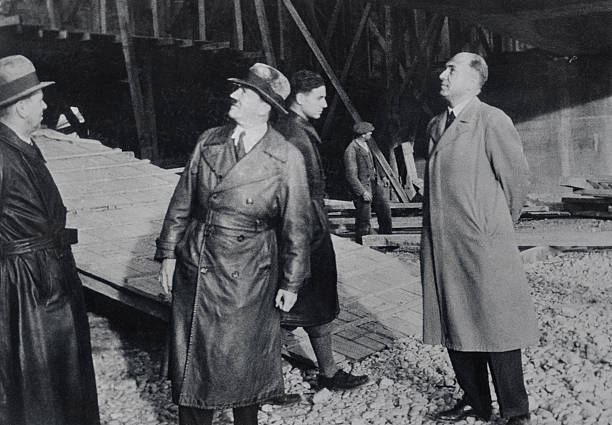
In a speech at the Berlin Motor Show on 11 February 1933, Hitler presented the Reichsautobahn as a necessity and as the future measure of a people, just as railroads had been in the past. Hitler and Göring at the Berlin Motor Show on 11 February 1933.Hitler with Todt (center) and Speer (far right) looking at the model of a motorway viaduct, 3 October 1937. Photograph by Heinrich Hoffmann.
The Reichsautobahn was also prominently featured in the 1937 exhibition Gebt mir vier Jahre Zeit (Give Me Four Years) celebrating the first four years of the regime’s achievements. A model of one of the huge pylons of the Mangfall Bridge at Weyarn, a girder bridge designed by German Bestelmeyer that spanned the valley on two double pylons of reinforced concrete, dominated the Reichsautobahn exhibit. Completed in 1936, this bridge served as the model for several subsequent autobahn bridges.
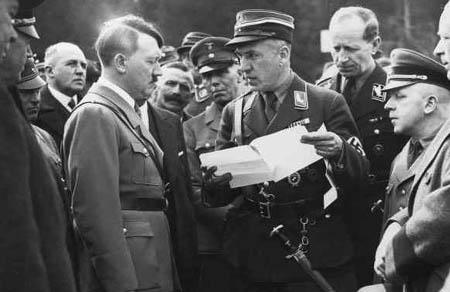
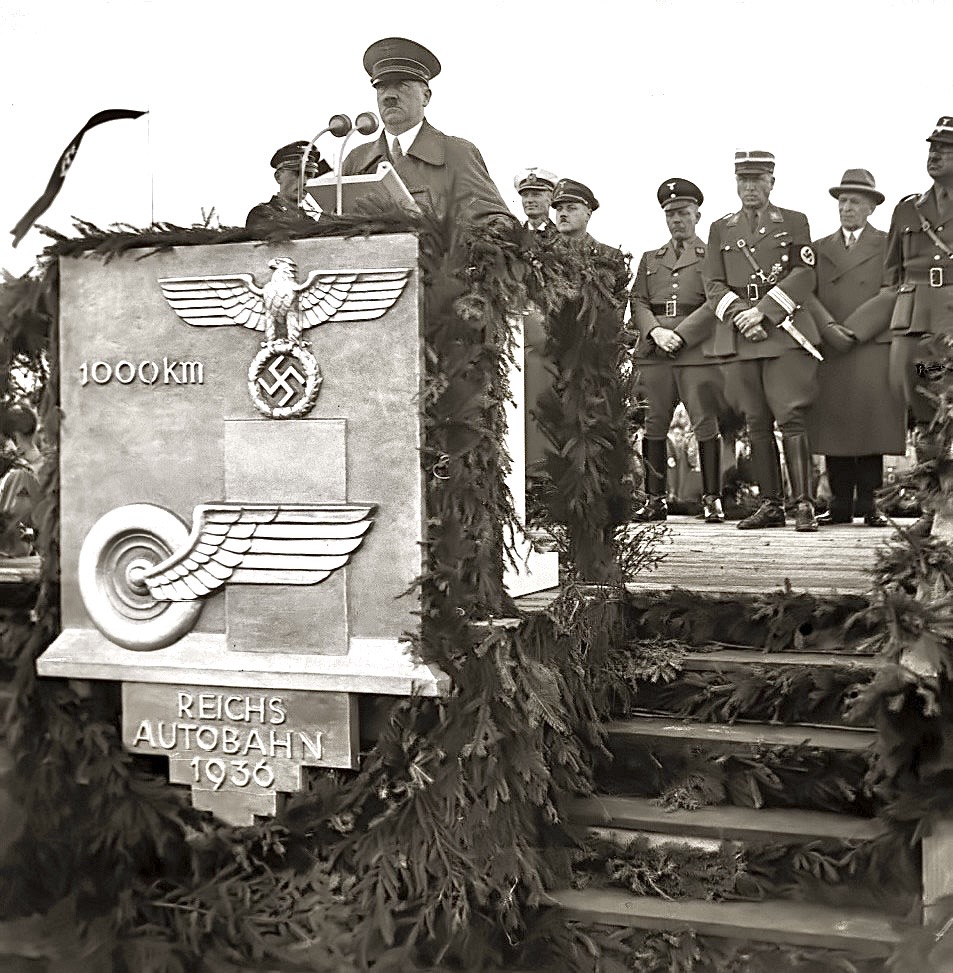
Adolf Hitler arrives in Weyarn on 6 May 1935 to view the construction progress on the Mangfall Bridge and is greeted in the valley by several local boys in the Hitler Youth.Adolf Hitler visits the construction site on the Reichsautobahn near the Mangfall Bridge in the Bavarian Alpine foothills on 6 May 1935. The bridge over the Mangfall River Valley, located to the southeast of Munich, was the first long-length bridge in the Autobahn system.Adolf Hitler visiting the construction site to view progress of the building of the Mangfall bridge on 6 May 1935. The Autobahn between Munich and Salzburg was important to Hitler since he traveled the route often, passing through that part of Germany in order to reach his home in Berchtesgaden. Hitler took a special interest in the Mangfallbrucke, which was 330-meters long and 68-meters high. Cigarette card from ‘Adolf Hitler: Bilder Aus Dem Leben Des Führers’ with the Official Caption: “Sammelwerk Nr. 15, Bild Nr. 118, Gruppe 63. In the summer of 1935 at the Mangfall Bridge” Hitler had traveled from Munich to visit the construction site of the bridge on 8 August 1935. When it opened in January 1936, Hitler was first to drive across the bridge. This segment of the autobahn was officially opened to traffic on 11 January, and the bridge became the model for many that followed.Adolf Hitler walks with an energetic step over the Neckar Bridge near Mannheim. The bridge connects the Autobahn motorway between Frankfurt and Heidelberg and was completed in October 1935. With a length of about 400 m, it served as a crossing point over the Neckar Channel, the Neckar River and for its riversides, and was replaced by a new bridge in 2005.Adolf Hitler in really high spirits at the inauguration of the rebuild of the Ludwigsbrücke in Munich on 3 November 1935.Adolf Hitler at the official opening of the new Ludwigsbrücke in Munich on 3 November 1935. The new Ludwig Bridge in Munich is opened. The Führer tears the ribbon: To the left of the Führer: Reichsleiter Amann; Councillor Christian Weber; the Führer’s deputy, Rudolf Hess. To the right behind the Führer: Lord Mayor Fiehler, on the far right Gauleiter State Minister Adolf Wagner.Adolf Hitler stands at the A9 Saale Bridge near Hirschberg on a newly opened stretch of the Autobahn from Leipzig-Bayreuth. The bridge is approximately 32 m high and has 8 vaults made entirely of granite. Construction began in July 1935 and it opened on 27 September 1936. The executing company was “Beton-und Monierbau-AG” with around 400 workers. Adolf Hitler with the General Inspector of the German Highways, Fritz Todt, inspecting the construction works for the Reich Autobahn Munich – Salzburg at Unterhaching on 21 March 1934. Between the two of them the Reich Organization Leader of the NSDAP, Robert Ley.V.l.n.r.: Julius Dorpmüller (angeschnitten), Joachim von Ribbentrop, Robert Ley, NN, Hitler, Todt (mit Dokument in Händen), NN, Max Amann Aufnahmedatum: um 1934. Adolf Hitler with Fritz Todt inspecting the construction works for the Reich Autobahn Munich – Salzburg at Unterhaching on 21 March 1934.Fritz Todt and Adolf Hitler meet at the Hotel Post on the Hintersee. Fritz Todt, the General Inspector for German Road Engineering, shows photos to Adolf Hitler about the progress of work on the Reich Motorway in July 1934.Adolf Hitler and Fritz Todt look at the relief map of a new highway route displayed at the reception and speech held for the delegates of the World Association of Automobile Clubs at the Reich Chancellery in Berlin on 11 May 1935. Published in: the ‘Berliner Morgenpost’ 19.05.1935.Adolf Hitler looks at a model of the new Elbe bank design in Hamburg; next to Hitler is Dr. Fritz Todt, General Inspector for German Roads, Adolf Hühnlein, Corps Commander of the Nazi Motor Corps (NSKK), Reichsführer SS Heinrich Himmler; after left: Gauleiter and Reich Governor Karl Kaufmann, General Admiral Erich Raeder, State Secretary Georg Ahrens and the First Mayor of Hamburg, Carl Vincent Krogmann on 29 March 1938. Heinrich Hoffmann postcard showing Adolf Hitler and Dr. Fritz Todt studying a map of the Reichsautobahn during the official opening of Breslau-Kreibau (Wrocław-Krzywa) on 27 September 1936.Construction of the Reichsautobahn Imperial Highway: Adolf Hitler makes a speech at the opening of the 1000th Kilometers on the stretch of road Breslau-Kreibau (Wrocław-Krzywa) on 27 September 1936 (behind Hitler from left: Paul Freiherr von Eltz-Ruebenach, Fritz Todt, Gauleiter Josef Wagner)
The celebration of the first 1,000 km took place on 27 September 1936 at Breslau. Five segments opened to traffic this day. 2,000 km were completed by the end of 1937, and 3,000 km by the end of 1938.
On the occasion of the completed 1000th km Reichsautobahn, Hitler visits the Breslau-Lignitz motorway near Breslau. A lady broke through the barriers to shake Hitler’s hand.
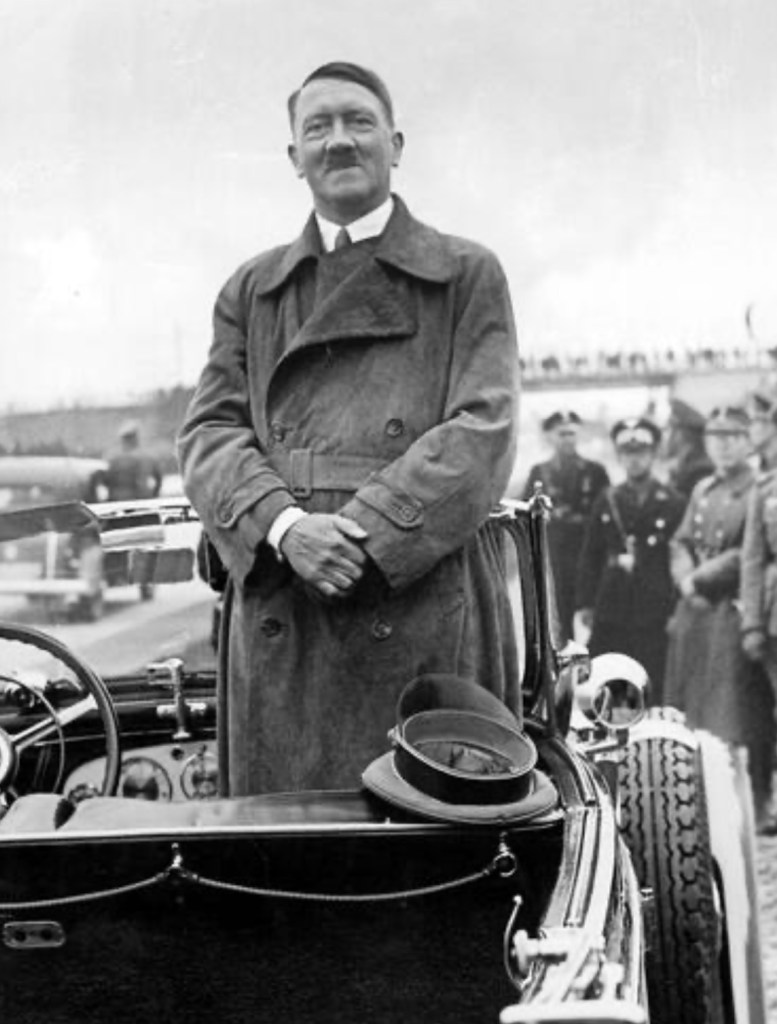
Adolf Hitler in his car at the completion of the 1000th Kilometer of the highway near Breslau on 27 September 1936.
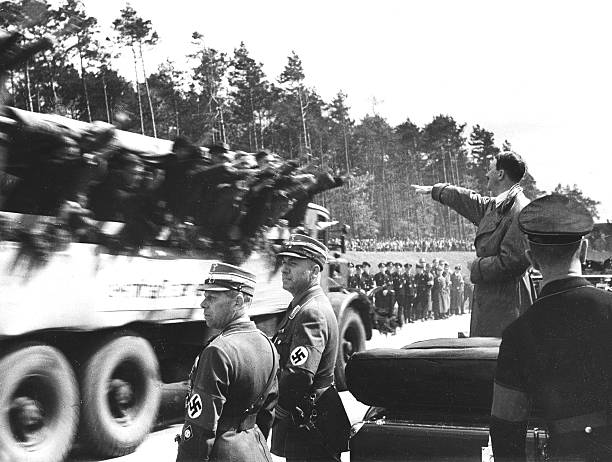
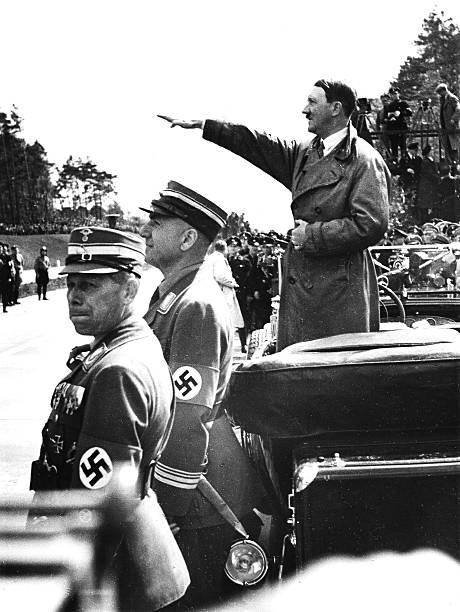
Inauguration of the Reich highway from Wroclaw to Liegnitz, 1936. Adolf Hitler standing in his Mercedes, drives past a formation of the assembled regiments during the inauguration of the section of the Reich highway from Wroclaw to Liegnitz. Also visible in the car is the General Inspector for German roadways Fritz Todt.
After the annexation of Austria the planned motorway network was expanded to include the Ostmark, and a second ground breaking ceremony for the first Reichsautobahn on formerly Austrian territory took place near Salzburg on 7 April 1938. When work ceased in 1941 because of World War Two, 3,819 kilometers (2,373 miles) had been completed.
The second sod-breaking ceremony for the first Reichsautobahn on formerly Austrian territory took place near Salzburg on 7 April 1938.Adolf Hitler poses with Fritz Todt at an Autobahn groundbreaking ceremony for the Reichsautobahn between Salzburg and Vienna on 7 April 1938.Adolf Hitler with a spade in the groundbreaking ceremony of Reichsautobahn between Salzburg and Vienna on 7 April 1938.
The Queralpenstrasse
Another massive road construction project that was initiated under Hitler’s direction was the Queralpenstrasse (German Alpine Road) built in the mid-1930’s. The road runs for 484 kilometers from Lindau on Lake Constance to Schönau am Königssee. Hitler frequently traveled this road and even made a special trip to observe the progress being made along the route on an Easter holiday excursion in April 1936 with Eva Braun. Even to this day, this lofty winding road offers grandiose views as it connects many of the most famous sights across Bavaria.
Eva Braun took this photograph of Hitler on 16 April 1936 while on an Easter holiday excursion traveling on the Queralpenstrasse (German Alpine Road). This winding rural road was created as a holiday route to connect the most famous sights of Bavaria. Construction was halted during WWIl and it wasn’t until 1960 that the entire project was completed.Adolf Hitler in conversation with the Inspector General for German roads, Dr. Fritz Todt, during an inspection of the completed section of the Transalpine Road from the ‘Mauthäusl’ near Bad Reichenhall to Inzell; to the right of Todt, the deputy press chief of the Reich government, Alfred Ingemar Berndt on 14 April 1936.
I love history and have always been infatuated with the design and style of the 1920’s. Unfortunately I can’t time travel back to this era, so I live vicariously through books, movies and photos.
[…] affair and forbid her from making any further films in Germany. Adolf Hitler at the opening of the Reichsautobahn Darmstadt-Frankfurt on 19 May 1935. With the opening of the short section of the […]
[…] on pace with aviation. He also laid out his plans to build a major nationwide highway system, the Autobahn, as well as a means to insure Germany’s domination in international motorsport with state-funded […]
[…] clearly posed this photograph of Adolf Hitler being chauffeured down a newly opened stretch of the Reichsautobahn in 1936, note how the rearview mirror is tilted in Hitler’s direction instead of towards the […]
[…] production, initiate numerous building and architectural projects and further develop the Autobahn system. The following are examples of souvenirs produced for the exhibit that included a variety of […]
[…] Ludwig Fichte (Head of the Measurement Office). Adolf Hitler at the Saale-bridge of the new build Autobahn Leipzig-Bayreuth – 1937- Photographer: Presse-Illustrationen Heinrich Hoffmann- Published by: […]



























 Heinrich Hoffmann Photo Gallery