
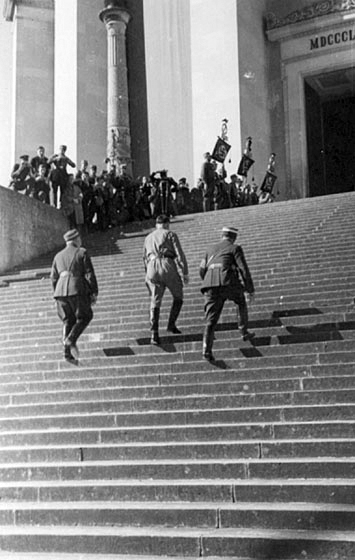
On 22 October 1933, the “German Day in Kelheim” (officially titled as the “Liberation Celebration” ) was celebrated. The newly crowned Reich Chancellor Adolf Hitler came to Kelheim for this very special occasion. Twenty years after Kaiser Wilhelm II and the German princes had celebrated the 100th anniversary of the Battle of Leipzig at the Befreiungshalle, Adolf Hitler arrived at the monument to mark the ceremonies for the 120th anniversary.

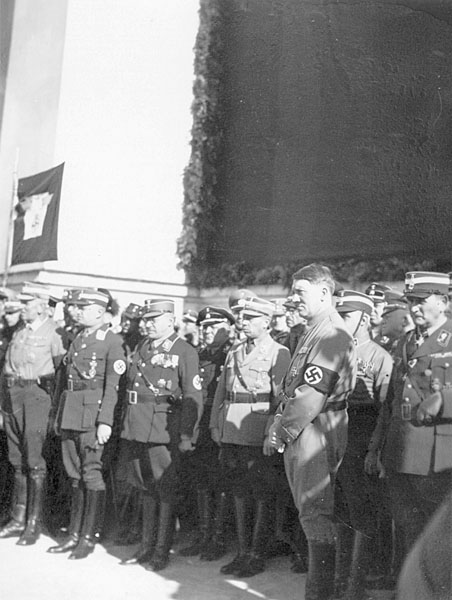
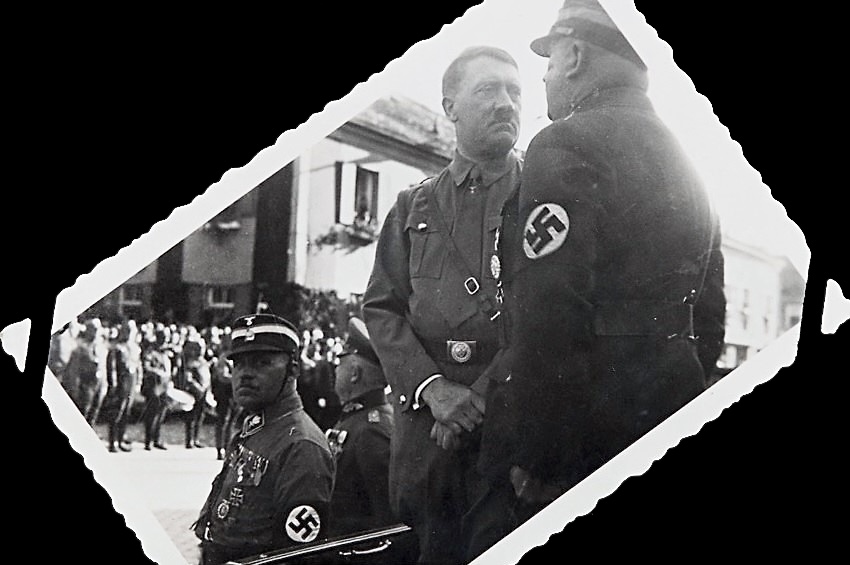
The events for the “Liberation Celebration” took place on a glorious autumn day. Around 11:00 a.m., the Führer arrived at the Befreiungshalle grounds in Gauleiter Adolf Wagner’s black Mercedes and was greeted by Chief of Staff Ernst Röhm, who inspected the SA front line in front of the hall. Following the firing of a 21-gun salute to welcome the Führer, Chief of Staff Röhm presented the Nazi Party insignia, featuring the swastika, displayed on the Liberation Hall (colloquially known as the “Hen Vulture” above the entrance door), to Adolf Hitler.

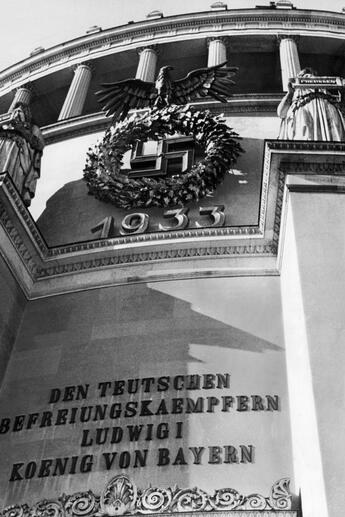
The Befreiungshalle is decorated with a huge bronze swastika, which was attached above the entrance to the hall, surrounded by an oak leaf wreath with an imperial eagle, and the year 1933.
During the first year of Nazi rule the Befreiungshalle (Hall of Liberation), a monument commemorating the victories against Napoleon, was decorated with National Socialist symbols.

The Befreiungshalle, or “Hall of Liberation,” is a neoclassical monument located in Kelheim, Bavaria, and was built between 1842 and 1863. It was commissioned by King Ludwig I of Bavaria to commemorate the victories against Napoleon’s armies during the Napoleonic Wars from 1813 to 1815. The ceremonial opening in 1863 marked the 50th anniversary of the Battle of Nations near Leipzig. An inscription in the marble floor reads: “Möchten die Teutschen nie vergessen was den Befreiungskampf nothwendig machte und wodurch sie gesiegt” (“May the Germans never forget what made necessary the Struggle for Freedom and by what means they won”).



It is no coincidence that both Kaiser Wilhelm II and Adolf Hitler visited the Liberation Hall near Kelheim (Lower Bavaria). The neoclassical circular building on the Michelsberg above the confluence of the Danube and Altmühl rivers is a first-class national monument. Commissioned by King Ludwig I of Bavaria to commemorate the Wars of Liberation against Napoleon and the Battle of Leipzig (October 18, 1813, hence the eighteen-sided floor plan), it was built by Friedrich von Gärtner and, after his death in 1847, by Leo von Klenze. Sculptures by Ludwig von Schwanthaler, among others, were added. The foundation stone was laid on October 19, 1842. The ceremonial opening took place on October 18, 1863, the 50th anniversary of the Battle of Leipzig. With a height of 45 meters and a diameter of 29 meters, the domed hall of the Liberation Hall is larger than the Roman Pantheon.
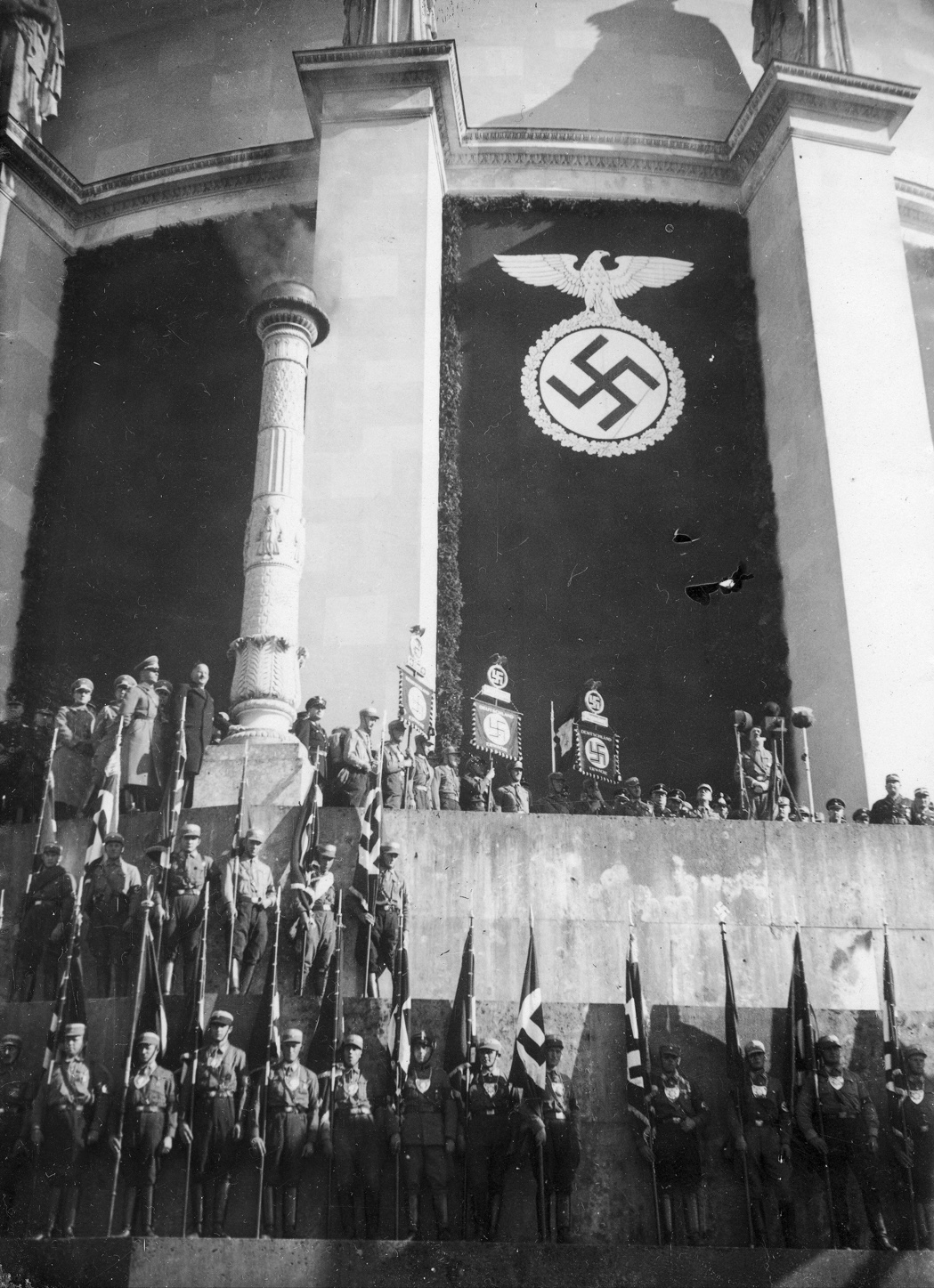


Blick von der Befreiungshalle auf die versammelten SA-, SS- und Stahlhelm-Verbände.

After expressing his gratitude in a short speech, Hitler, accompanied by Röhm and Reich Governor Ritter von Epp, entered the hall and laid a large laurel wreath in memory of those killed in the Wars of Liberation. As the Reichswehr left the Liberation Hall toward the city center, it fired another 21-gun salute. During the lunch break that followed, the Führer was presented with the honorary citizenship certificate of the city of Kelheim by the mayor of Kelheim, Dr. August Donderer.


From 1:00 p.m. until the end of the event at 3:00 p.m., approximately 18,000 SA and SS soldiers marched past the Führer in six-deep rows with raised hands in front of him, who was standing in his car, at Ludwigsplatz. To make this possible, the monument to King Maximilian was summarily removed from the old town.
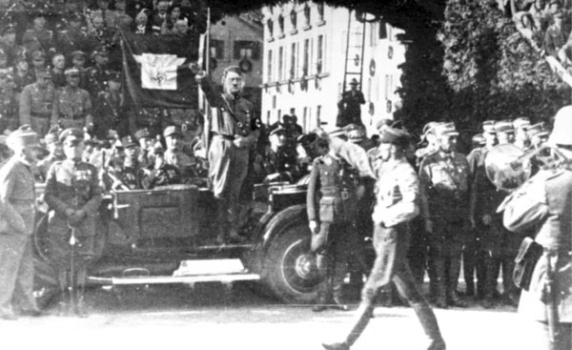


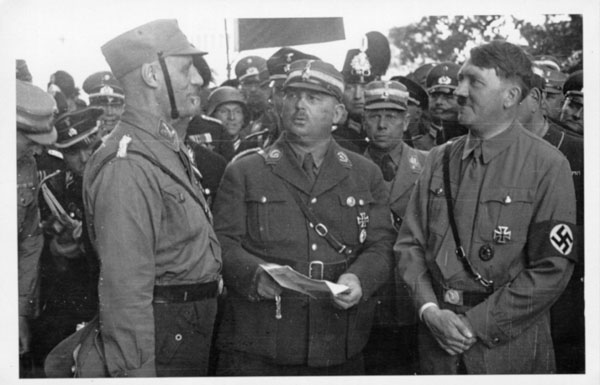
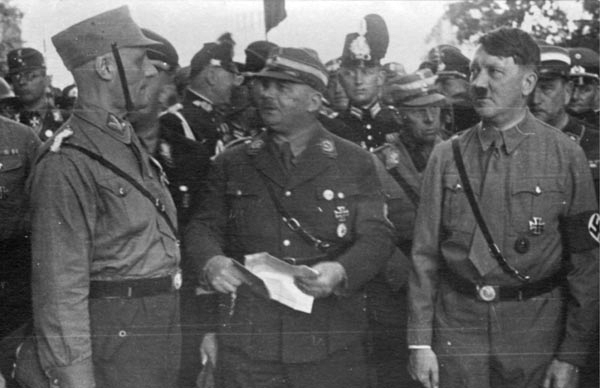

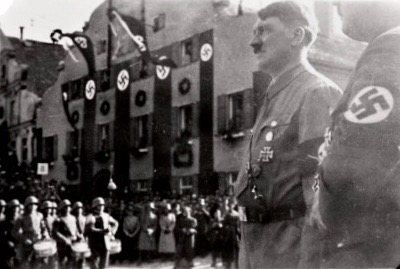
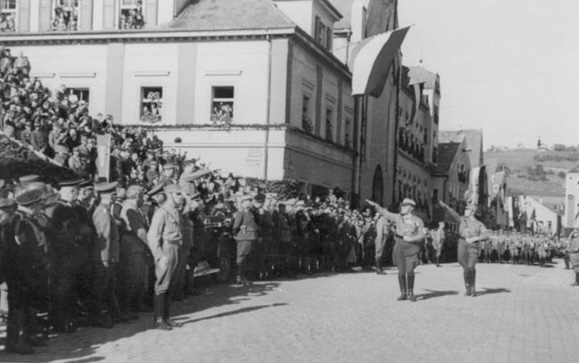
Hitler took about 18,000 SA and SS members to a march past on Kelheim’s town square after the Reichswehr fired another 21 gun salute. Coming from the Altmühltor, the ancient city gate, they marched for two hours in rows of six and in blocks of 500 men, each “with their hands raised” to Hitler. Five Reichsmarks had to be paid for a seat in the stands. It wasn’t until midnight that the festivities in the overcrowded town ended.


Adolf Hitler erhält das Ehrenbürgerrecht durch den Stadtrat von Kelheim.
Certificate for the awarding of Kelheim’s honorary citizenship to Hitler.

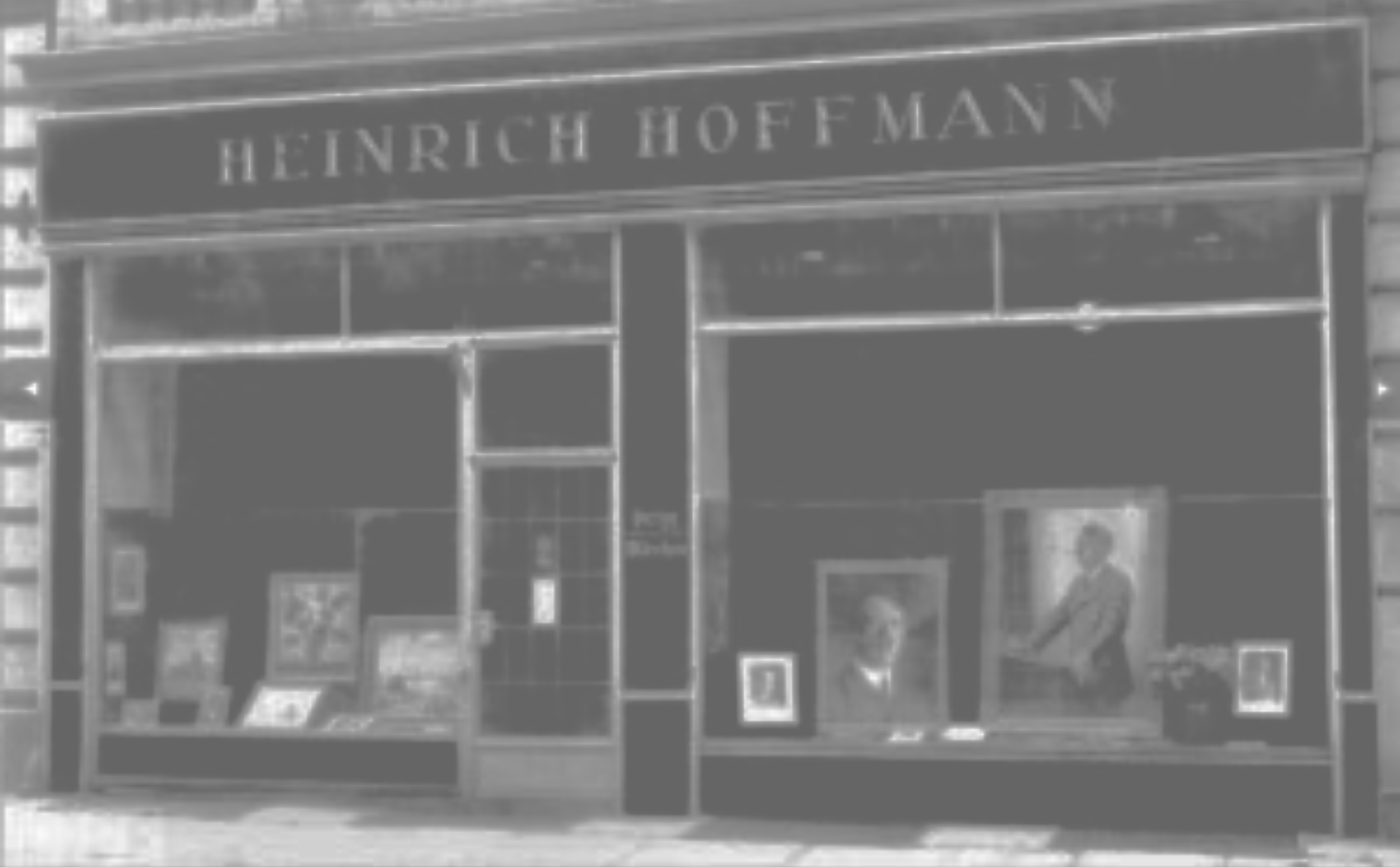
 Heinrich Hoffmann Photo Gallery