Heinrich Hoffmann (1885 – 1957) served as Adolf Hitler’s official photographer from when Hitler took control of the Nazi party in 1921 until his death in 1945. Hoffmann estimates he took over half a million photographs of Hitler over the course of his career. His portraits were the most significant source of Nazi propaganda materials published over the course of close to 25 years, everything from postcards, posters, magazines, postage stamps and picture books. Click on eachtheme below to see a complete photo albumdevoted to that particular event or topic.
Ninety years ago today liberation celebrations were held on 1 March 1935 in Saarbrücken for the reintegration of the Saarland into the German Reich. The Treaty of Versailles had put the Saar under the control of the League of Nations for 15 years. During these years, the region was administered by the League – first run by a Frenchman, then by a Canadian and thirdly by a Briton. On 13 January 1935 a plebiscite (vote) was held where the inhabitants would decide whether they returned to Germany, or retained their separate identity. Over 90 percent of eligible voters approved the annexation of the Saarland to the German Reich, and on 1 March 1935, it was officially incorporated into the nation as the Saarland District. For Hitler, the Saar vote was a great source of prestige and proof of the power and popularity of the Nazi regime.
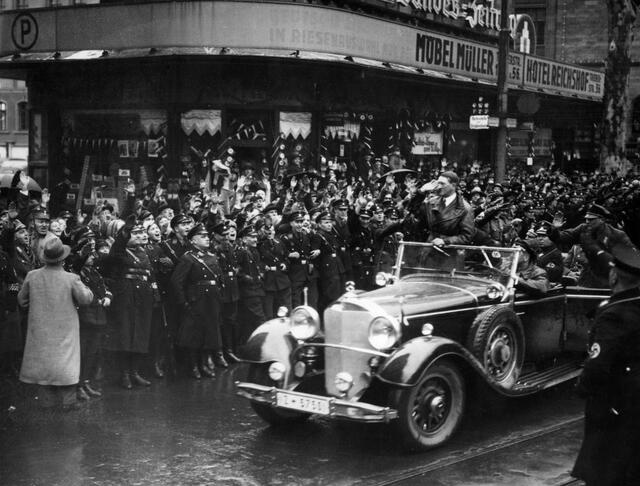
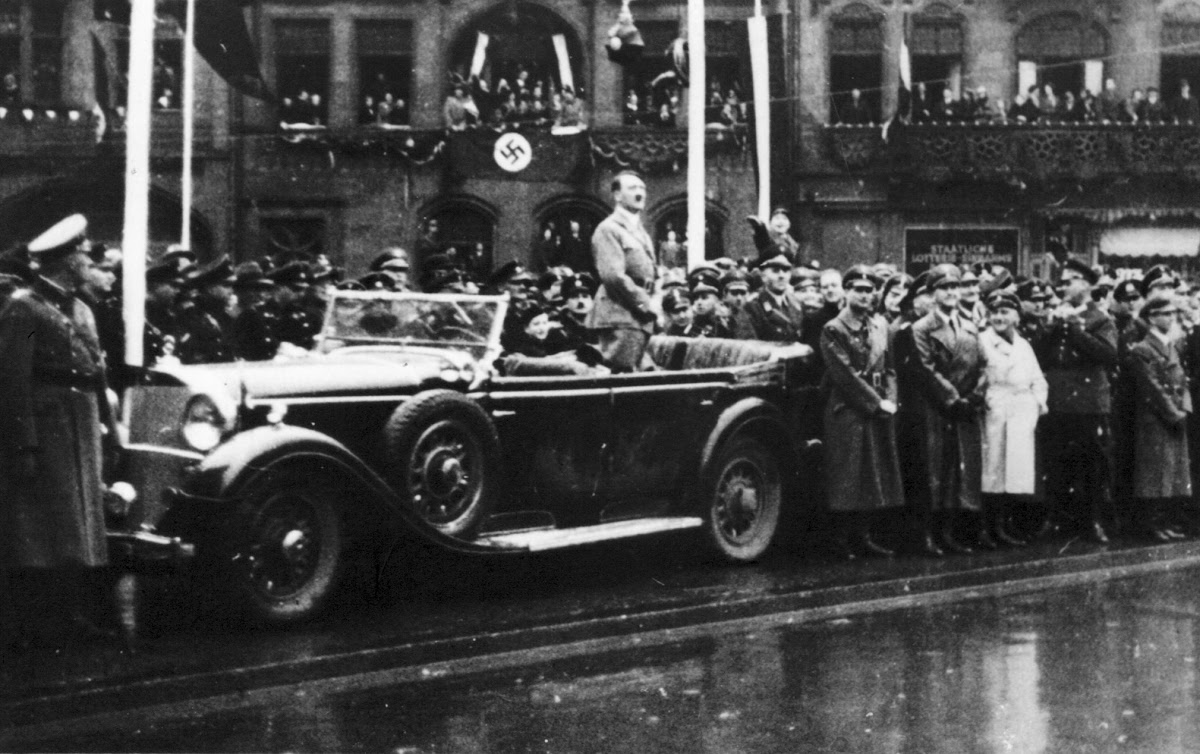
Adolf Hitler after the referendum on the Saar statute in Saarbruecken, 1935. Adolf Hitler (behind him Adjutant Julius Schaub) arrives in front of the Hotel Excelsior in Saarbruecken after the successful referendum on the annexation of the Saar region to the German Reich. He is greeted by an enthusiastic crowd.
With the liberation of the Saar there were celebrations without end. The day included a reception of the Three-Way Commission of the League of Nations and a massive parade of party formations, police troops and SS-Leibstandarte. Hitler addressed crowds at the Rathausplatz and delivered a speech in the Hotel Excelsior. There were eagle decorations and swastika banners everywhere. The Wehrmacht, the SA and the SS all marched into Saarbrücken as did Hitler himself, and the official ceremonies all welcomed the province back to the German homeland.
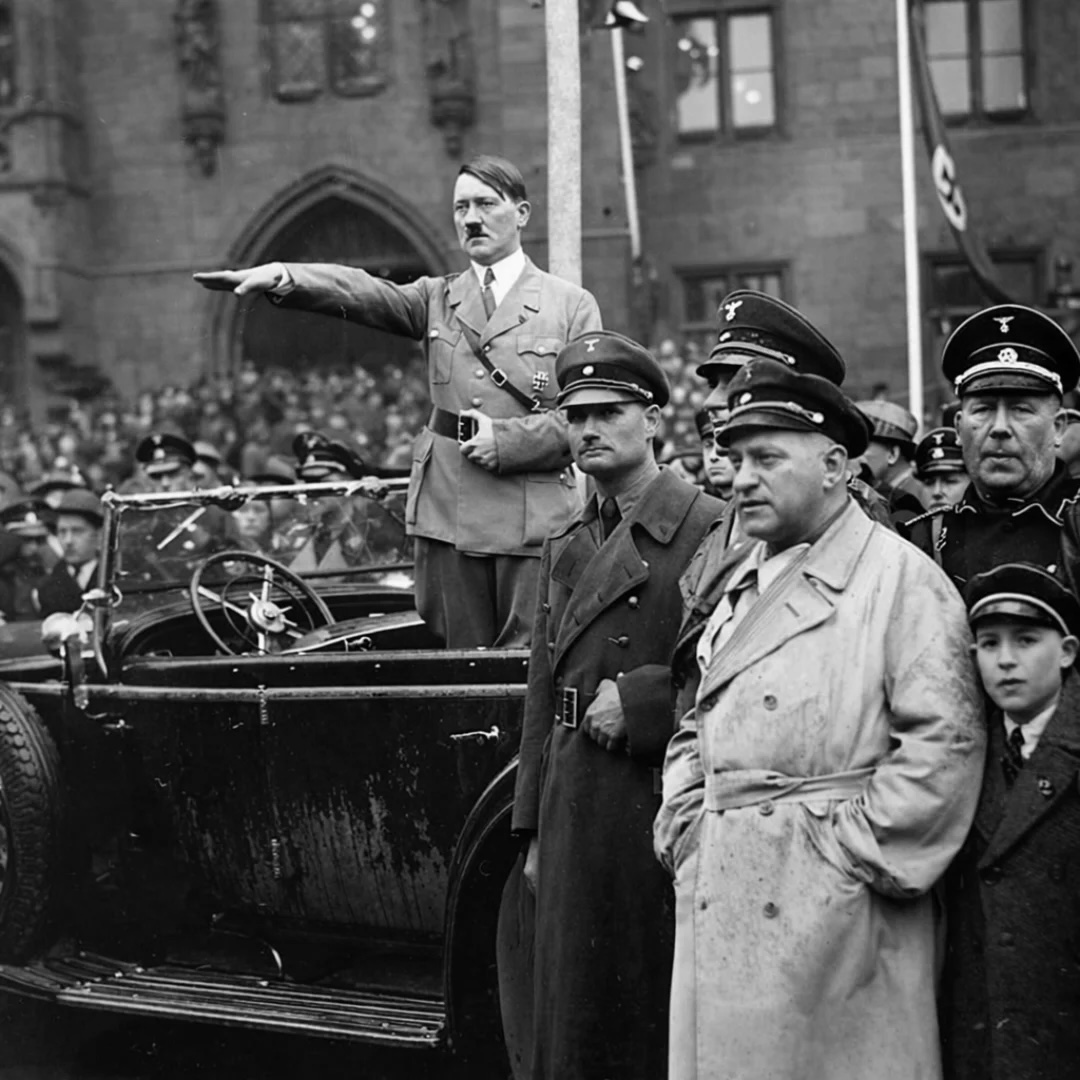
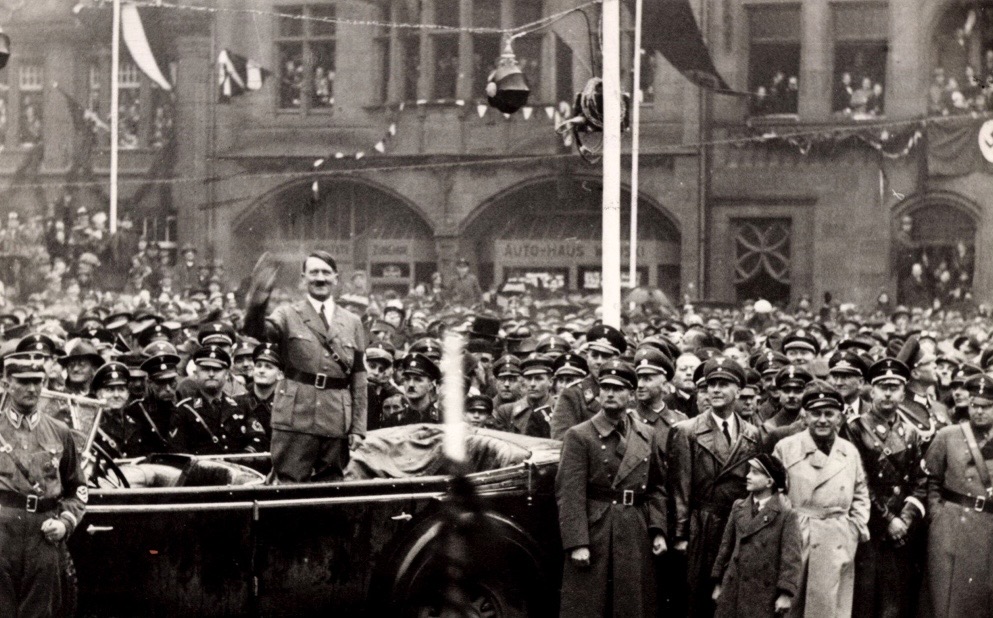
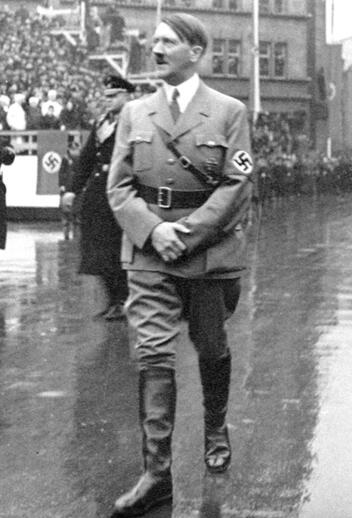
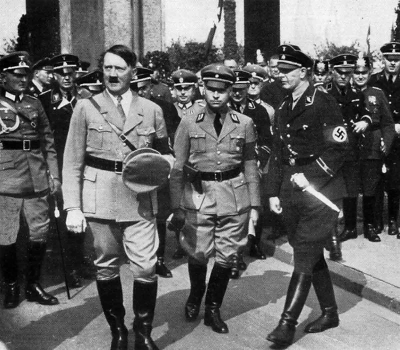
Adolf Hitler salutes the parade in front of the town hall in Saarbrücken, to celebrate the reintegration of the Saarland in the German ReichThe people welcome Adolf Hitler enthusiastically upon his arrival in Saarbrücken, Germany, on the occasion of the handover of the Saarland to Germany, which was until then administrated by the League of Nations, on 1 March 1935. Adolf Hitler on the balcony of the Hotel ExcelsiorAdolf Hitler in Saarbrücken Saarland is welcomed by a young boyAdolf Hitler on the town hall square with spectators gathered for a parade to celebrate the reintegration of the Saar 1 March 1935.The people welcome Adolf Hitler enthusiastically upon his arrival in Saarbrücken, Germany, on the occasion of the handover of the Saarland to Germany, which was until then administrated by the League of Nations, on 1 March 1935. Adolf Hitler takes the March Past of the party formations outside the town hall in Saarbruecken after the reintegration of Saarland to Germany Celebration of the reintegration of the Saar 1 March 1935.Adolf Hitler, whom the Saarlanders still relied on at that time, was also celebrated A great parade was held in the afternoon of 1 March 1935 on the occasion of the reintegration of the Saar region into the German Reich. In addition to Adolf Hitler himself, the majority of high-ranking officials of the Nazi regime had travelled to Saarbrücken and celebrated this great electoral success. The delegation from Berlin was welcomed by a frenetic crowd of Saarbrücken’s inhabitants in front of the St. Johann town hall.Hitler nimmt den Vorbeimarsch von Formationen vor dem Rathaus in Saarbrücken ab.Adolf Hitler salutes the parade in front of the town hall in Saarbrücken, to celebrate the reintegration of the Saarland in the German ReichAdolf Hitler reviews SA troops during a parade in front of the town hall in SaarbrückenDer Führer auf dem Balkon des Rathauses
After 1919, the Saarland and its approximately 800,000 inhabitants came under French control under a League of Nations mandate. The Versailles Treaty stipulated that a popular referendum was to be held fifteen years later to determine the region’s future. The Nazi propaganda machine ran at full tilt in the lead up to the referendum, which was scheduled for 13 January 1935. The regime organized countless rallies and mass events to convince voters of the absolute necessity of erasing the “shame of Versailles” and bringing the Saarland “home to the Reich.”
Adolf Hitler being welcomed in a celebratory ceremony by the population in Saarbrücken, Germany, on the occasion of the handing over of the Saargebiet to the German Reich, which was until then administered by the League of Nations.A citizen of Saarbrücken greets Hitler as he passes through town during the reunification ceremony.
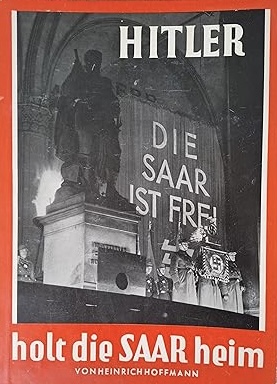
Hitler holt die Saar Heim tells the story of the German demand and the Allied return of the Saarland portion of Germany which had been occupied by British and Italian troops since the end of World War I. The occupation of the Saar was an extremely unpopular part of the Treaty of Versailles.
Josef Bürckel was named “Reichskommissar for the Return of the Saarland” to coordinate the acquisition. Gau Rheinpfalz was merged with the Saarland on 1 March 1935 to form Gau Pfalz-Saar (renamed Gau Saarpfalz in January 1936) and Bürckel continued as Gauleiter of the enlarged territory.
Wilhelm Frick, Josef Burckel (seated), Rudolf Hess and Adolf Hitler at the conference at which Herr Josef Bürckel was appointed Governor of the Saar by Hitler at the Chancellory at Berlin on 23 November 1934 during the Gauleitertagung.
Hitler eagerly listens to the radio in Berchtesgaden on 15 January 1935 awaiting the final results of the Saarland plebiscite. He then spent a week of special holiday time at his home on the Obersalzburg, which can be viewed in detail in the Tweed Suit album.
“Two years ago, in 1933, I spoke for the first time before many tens of thousands of Saarlanders at the Niederwald Monument. At that time, in the midst of one of the most difficult battles to establish our ideas and principles in the new Germany, I was filled by anxious concern for the future of the Saar.One year later I was already facing hundreds of thousands in Koblenz. Once more I was moved-as were you all-by a deep-felt concern for the future of this territory which had been torn from the Reich. At that time, we mutually pledged two things: You promised me that, when the hour should come, you would stand up, man for man and woman for woman, in support of Germany. You have kept your vow. I promised you that Germany would not desert you, never and nevermore, and Germany reciprocated and kept its promise; both times I was able to assure you with all my heart that I would be happy the day I would be able to reward you for coming to Koblenz.”
–Adolf Hitler’s speech in Saarbrücken on 1 March 1935
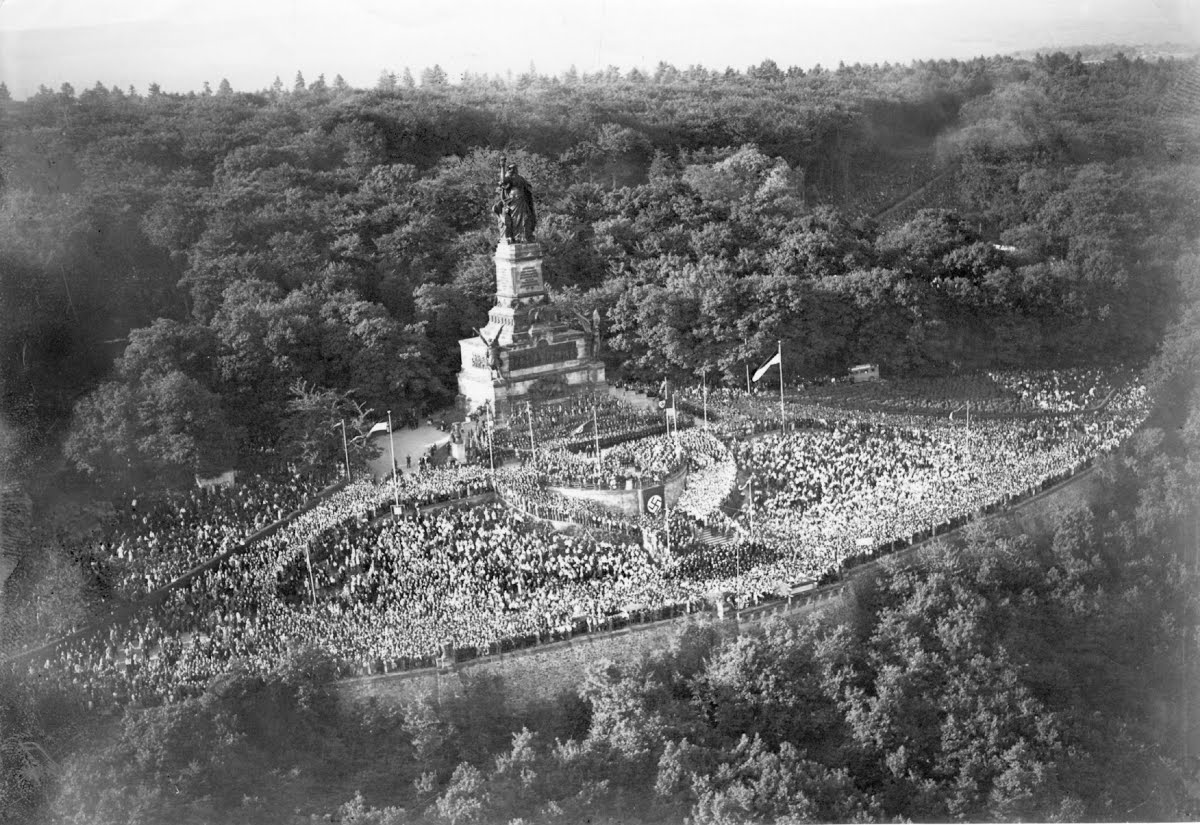
Saarland Rally at Niederwald
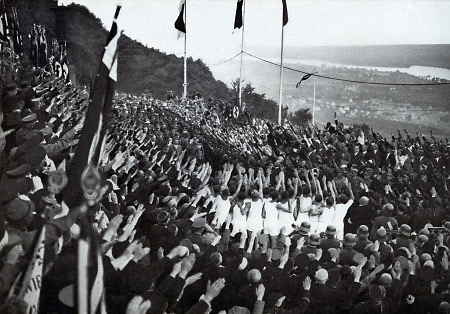
Adolf Hitler held a Saar loyalty rally at the Niederwalddenkmal on 27 August 1933. Located near Rüdesheim am Rhein, the monument was constructed to commemorate the foundation of the German Empire after the end of Franco-Prussian War. The first stone was laid on 16 September 1871 by Wilhelm I. The total cost of the work is estimated at one million gold marks. Hitler mentions seeing this monument on his way to the front at the start of the Great War in Mein Kampf:
“Finally, the day came when we left Munich in order to start fulfilling our duty. Now for the first time I saw the Rhine as we were riding towards the west along its quiet waters, the German river of all rivers, in order to protect it against the greed of the old enemy. When through the delicate veil of the dawn’s mist the mild rays of the early sun set the Niederwalddenkmal shimmering before our eyes, the ‘Watch on the Rhine’ roared up to the morning sky from the interminably long transport train and I had a feeling as though my chest would burst.”
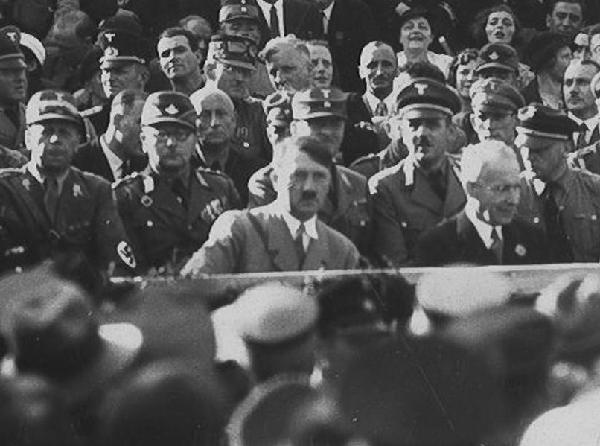
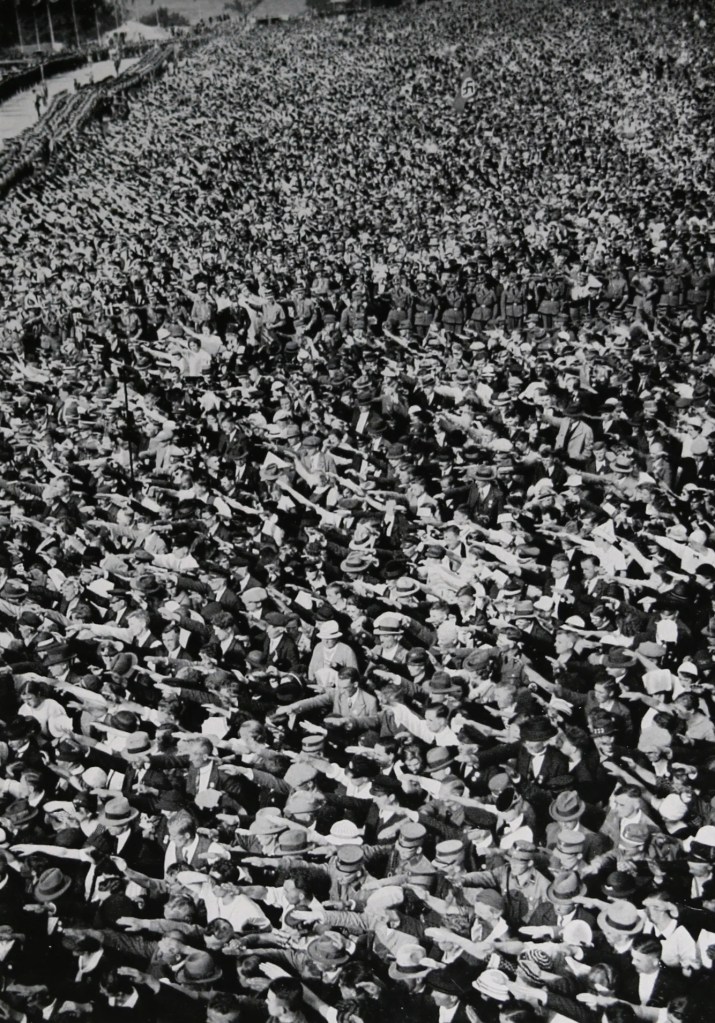
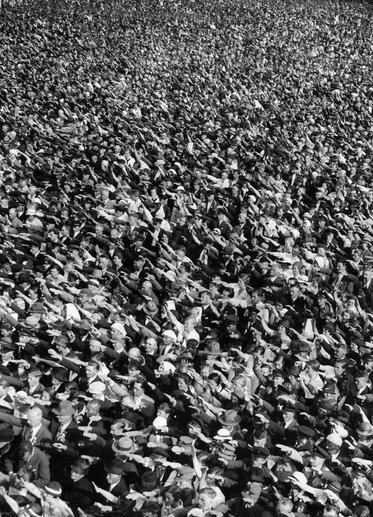
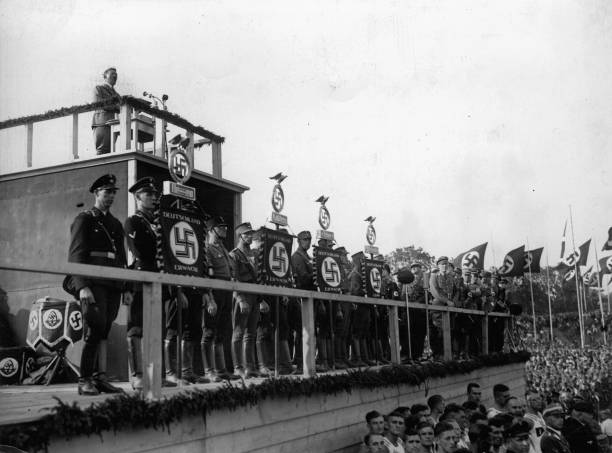
“The Saar remains German!” The giant rally at the Niederwalddenkmal on 27 August 1933. Among the hundreds of arms raised to the Hitler salute, Adolf Hitler can be recognized at the head of a larger group of people.Adolf Hitler speaks about the re-integration of the Saarland on 27 August 1933. Surrounded by members of the SS, Adolf Hitler speaks at an event during the run-up to a referendum about the re-integration of the Saarland to the German Reich at the Niederwalddenkmal (Niederwald memorial) at Ruedesheim. In the background is the Rhine.Die Saar-Kundgebung am Niederwald-DenkmalIn more than 40 special trains, buses and private vehicles came on 27 August 1933 more than 80,000 Saarlanders to a large Saar rally (Saarkundgebung) to the Niederwalddenkmal near Rüdesheim, at which Hitler spoke as Reich Chancellor. Simultaneously in Neunkirchen, about 5,000 people came to an SPD event taking place for a “free Saar” and against the Hitler dictatorship.Adolf Hitler in front of the Niederwalddenkmal monument looking down at the town of Rüdesheim below on 21 August 1930. Niederwald was a monument erected to commemorate the victory in the war with France (1870-1871) and the creation of the German Empire. Construction began in 1877 and took six years to complete.
Saarland Rally at Ehrenbreitstein
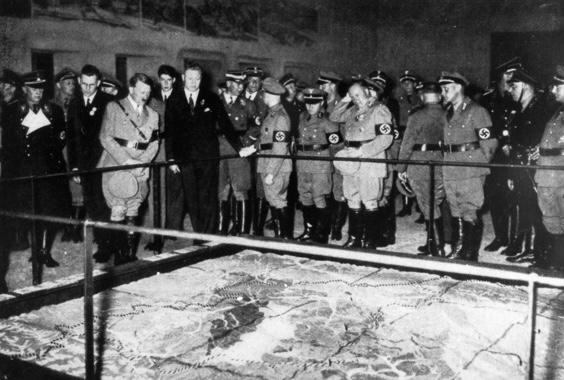
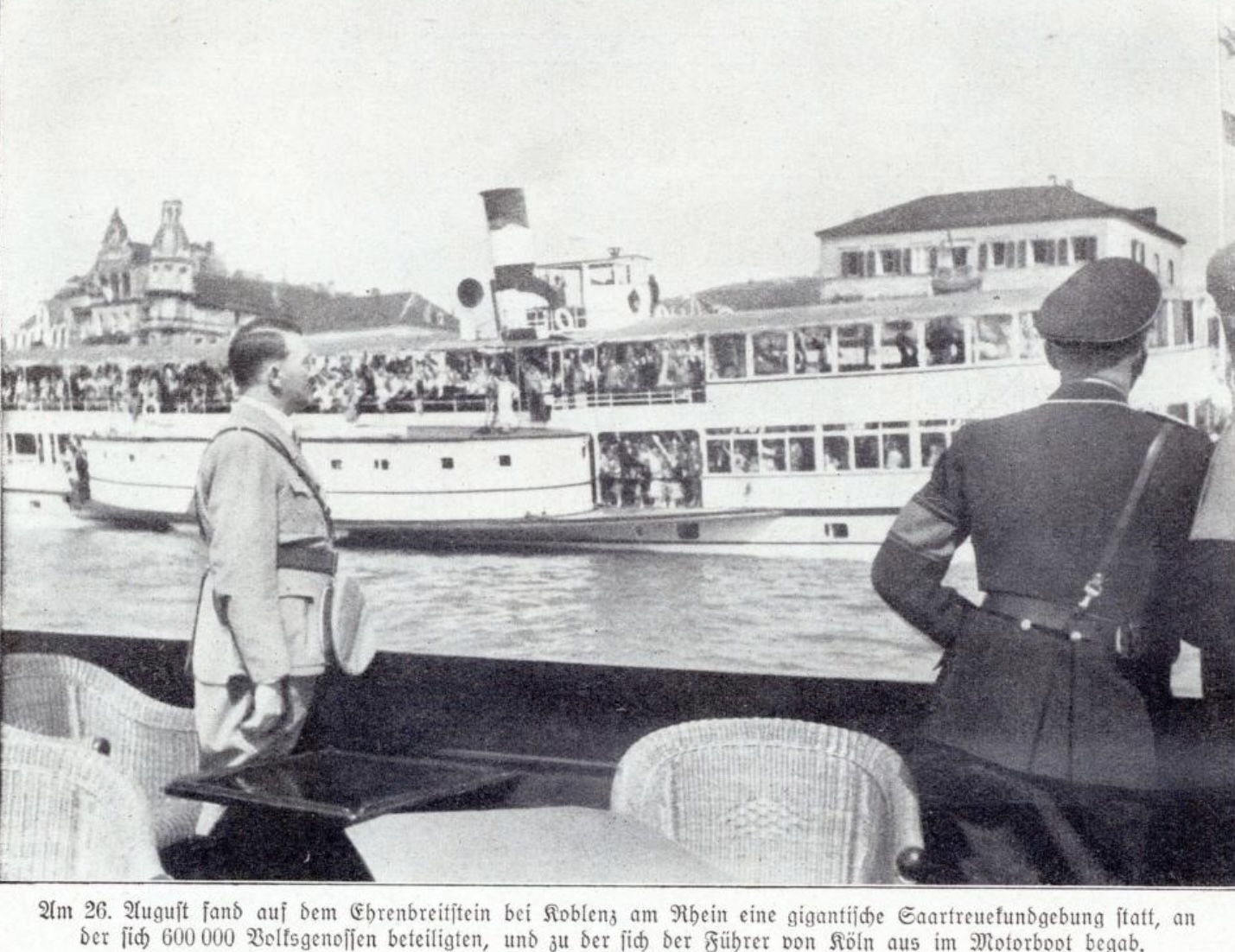
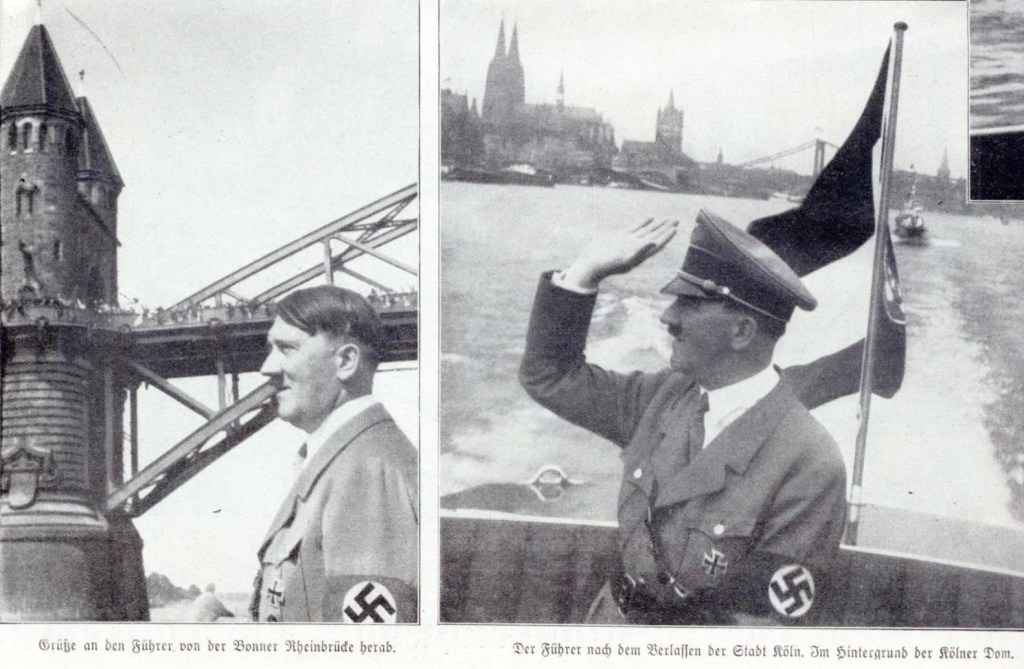
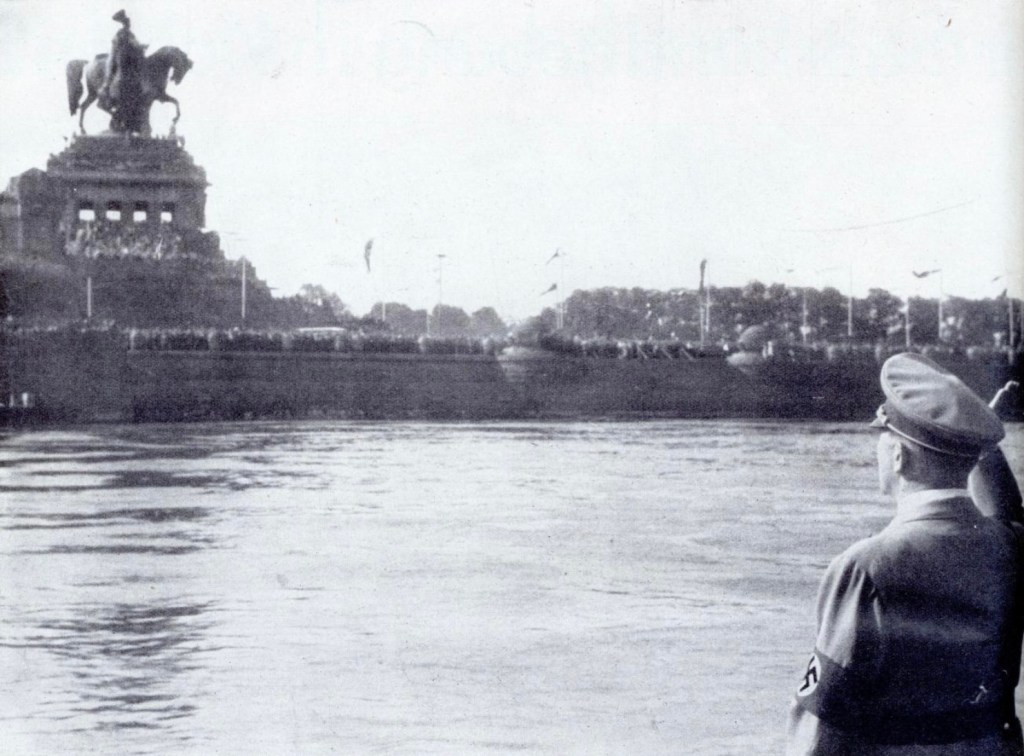
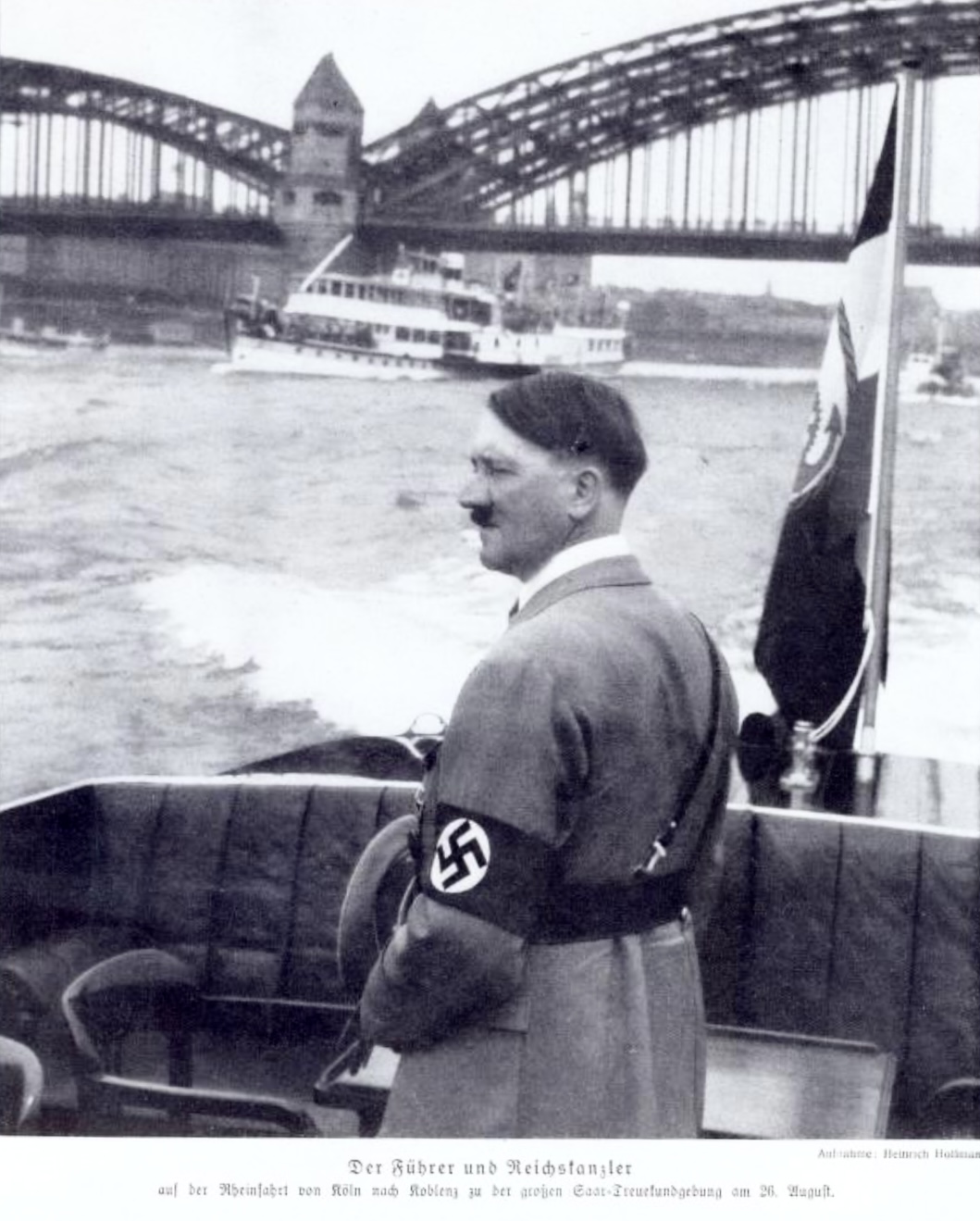
Earlier on the same day as the special Saarland rally held at the Ehrenbreitstein Fortress in Koblenz, Hitler had visited the Saar exhibition and attended a special reception held in the town hall in Cologne. Hitler then took a boat trip down the Rhine to Koblenz. His speech was delivered at the Saartreue rally on the plateau of the Oberehrenbreitstein Fortress in front of 400,000 listeners.
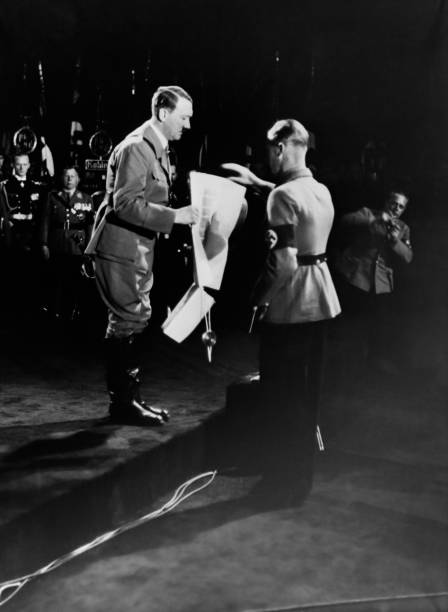
Hitler at the Saar exhibition in Cologne on 26 August 1934. During his stay in the Rhineland, Hitler visited the Saar exhibition in Cologne, which was opened by the Reich Propaganda Minister Joseph Goebbels. Hitler is accompanied by officers and party members, Joseph Goebbels (left of Hitler) and the Gauleiter of Cologne, Josef Grohe (2nd from right), during the tour of the exhibition.Adolf Hitler arrives in Köln to visit of the Saarausstellung in the MesshalleAdolf Hitler recevant une lettre de félicitation à l’occasion de son dernier cours’une conférence, à Cologne, Allemagne.Besuch d.Saar-Ausstellung 26. August 1934. Hitler vor e.Reliefkarte d.Saargebiets.Hitler departs Köln and boards a ship for a cruise down the Rhine to Koblenz.On August 26th, a gigantic Saar loyalty rally took place on the Ehrenbreitstein near Koblenz on the Rhine, in which 600,000 fellow Germans participated, and to which the Führer travelled from Cologne by motorboat.From the land, from the brethren, and from the Rhine ships, enthusiastic shouts of “Heil!” echo incessantly to the leaderAdolf Hitler on the Ehrenbreitstein, 1934. Adolf Hitler arrives on the Ehrenbreitstein near Koblenz, where the Loyalty Rally for the Saar (Saartreue Kundgebung) took place. He is followed by a group of Nazi leaders, among them, with their backs to the photo and in conversation either Martin Bormann or Karl Bodenschatz, further to the left Joseph Goebbels, to the right of him Hans Heinrich Lammers as SS Gruppenfuehrer and to the right of him Sepp Dieetrich, Commander of the SS Leibstandarte Adolf Hitler. The gentleman with the top hat behind Goebbels is Bartholomaeus Kossmann, who was a member of the government commission of the Saar region. The soldiers on the right side must be the Italian contingent protecting the Saar referendum. During a rally for the connection and loyalty of the Saarland to the German Reich on the fortress Ehrenbreitstein near Koblenz, Adolf Hitler salutes one of the 170,000 attending athletes on 26 August 1934.Adolf Hitler and von Tschammer und Osten welcome the goalkeeper at the Saar Loyalty Relay Race 1934. About 170,000 athletes took part in the “loyalty relay race,” which commenced from ten different frontier points and finished in Koblenz.Hitler is handed a symbolic baton by a runner from Trier. Behind them SA men with a standard from Trier.A relay brings the greetings of the Saarland to the Führer at the rally at the Ehrenbreitstein Fortress.Hitler auf der Ehrentribüne anlässlich der Saartreuekundgebung auf der Festung Ehrenbreitstein, links hinter ihm Wittgen, 26. August 1934. On Ehrenbreitstein: From left to right: State Secretary in the Reich Chancellery Dr. Lammers; Reich Minister of Propaganda Dr. Goebbels; Führer and Reich Chancellor Adolf Hitler; Reich Minister of Transport Baron von Eltz-Rübenach; Reich Governor General Ritter von Epp.The choice of Ehrenbreitstein, a place with historical importance, added to the Saarland rally’s appeal to German national pride.An enormous crowd sings the ‘Saarlied’ and the ‘Deutschlandlied’ at a Nazi rally at Castle Ehrenbreitstein near Koblenz.A Saar German delegation swears an oath of allegiance to the German Reich in the Ehrenbreitstein Fortress during the meeting of the VDA at Rhine and Mosel.Adolf Hitler during a rally on the Ehrenbreitstein near Koblenz on the Saartreue (“loyalty to the Saar”). In 1935 a referendum was held for the Saar (Saar region) mandated area concerning the issue of whether to be admitted to the German Reich. As part of the Treaty of Versailles, the Saar region had been separated from the German Empire and then passed into French administration.Hitler delivers his speech in Koblenz on the topic of the Saarland being reunified with the German Reich .Close up of Hitler tucking his windswept forelock back into place as he delivered his speech at Koblenz.
I love history and have always been infatuated with the design and style of the 1920’s. Unfortunately I can’t time travel back to this era, so I live vicariously through books, movies and photos.
A lot of important and interesting information in this article, as well as a great variety of photos, as always. I particularly liked the close-up, and I enjoyed reading about Koblenz and Ehrenbreitstein. My mother lived in Koblenz many years, and I have been there, as well as on the impressive Ehrenbreitstein fortress, but I had no idea back then that this was an important site during Hitler’s time when the Saar was returned to Germany.
[…] majority of this set of photographs were taken in January 1935 at the time of the Saarland referendum when Hitler spent a weeks holiday at his Obersalzburg […]






















 Heinrich Hoffmann Photo Gallery