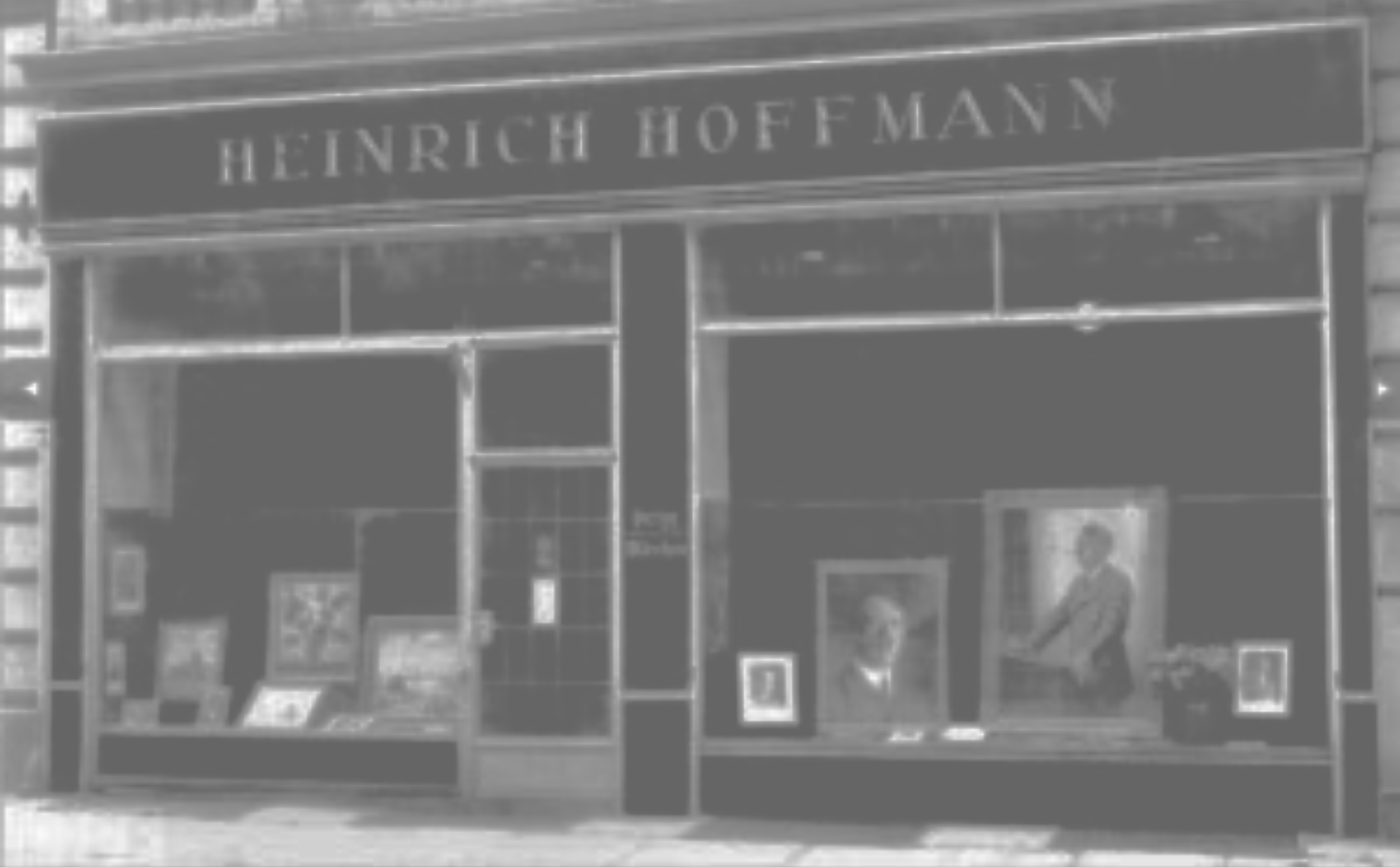

Exactly 103 years ago today on 6 April 1920 Heinrich Hoffmann joined the Nazi Party. When Adolf Hitler took control of the Party in 1921, Hoffmann became his official photographer and Hitler decreed that only Hoffmann would be allowed to take photographs of him. His photographs documented the next quarter century of Hitler’s career showing Nazi ceremonies, parades, training groups, youth groups (including Hitler Youth and Bund Deutsche Mädel), sports events, and workers’ meetings. As this website has mostly covered his well known photographic work, I thought I’d include some of the more unusual Nazi propaganda items that I’ve run across that utilize his photographs.
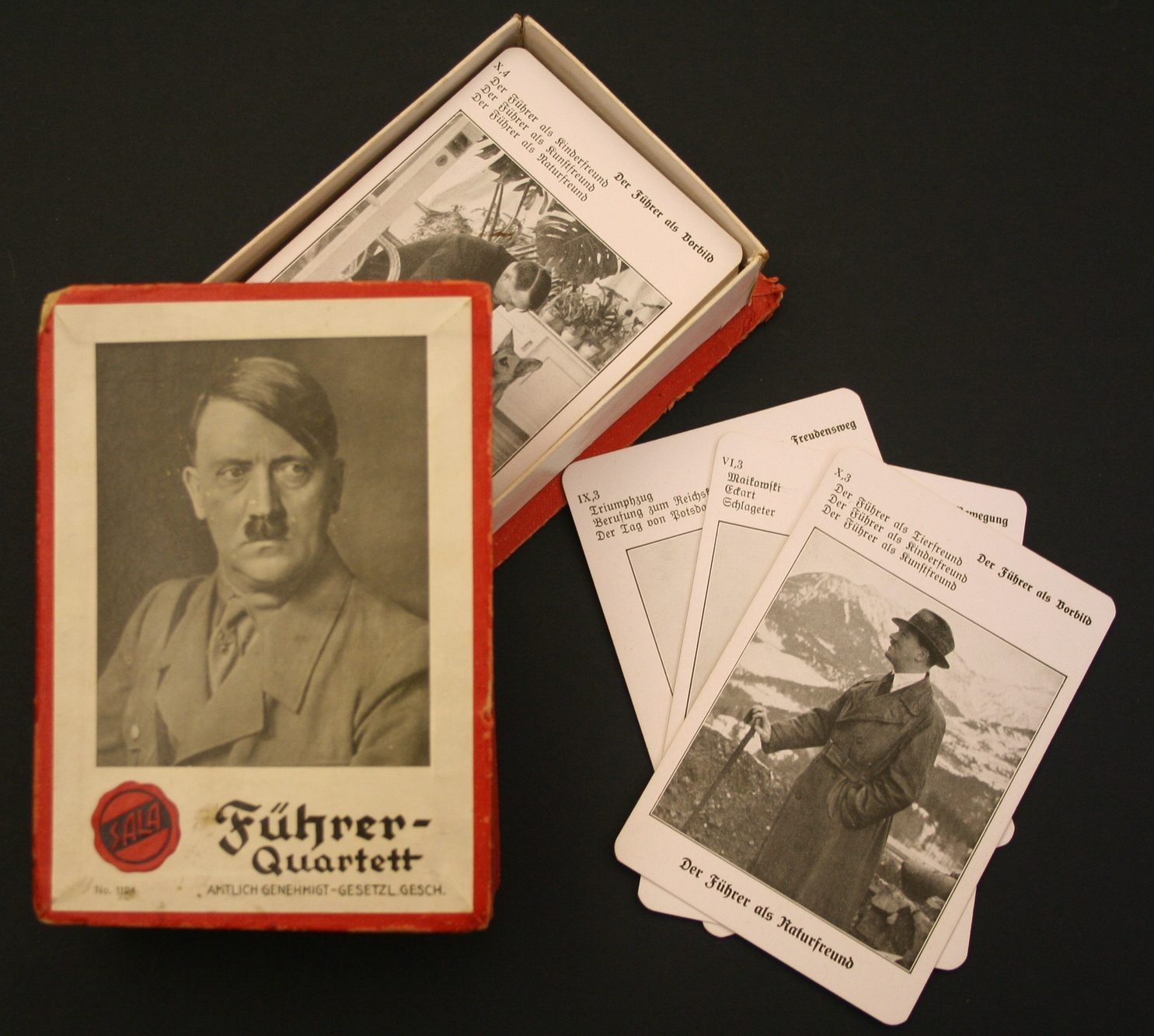
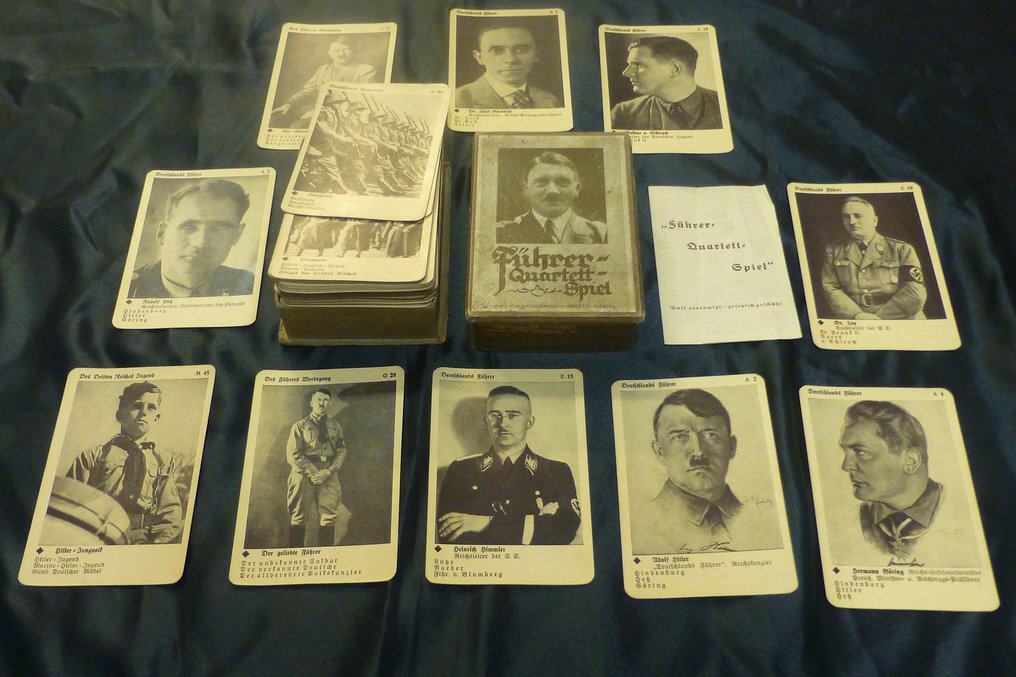
Playing Cards
‘Führer Quartett’ was a family game that consisted of a deck of 60 cards and was released in 1935. This Nazi card game was based on the traditional game of ‘snap’ with cards showing various images of Adolf Hitler, high ranking Nazis, and SA and SS soldiers. The game appears to have had two different versions, one creates a picture of Hitler’s rise to power and another features idyllic scenes from his private life. Each card was labelled with a number and letter (1A, 2A, 3A, 4A, IB, 2B, 3B etc.), and the aim of the game was to match and collect complete sets of 4 cards.
Winterhilfswerk Mini-Books
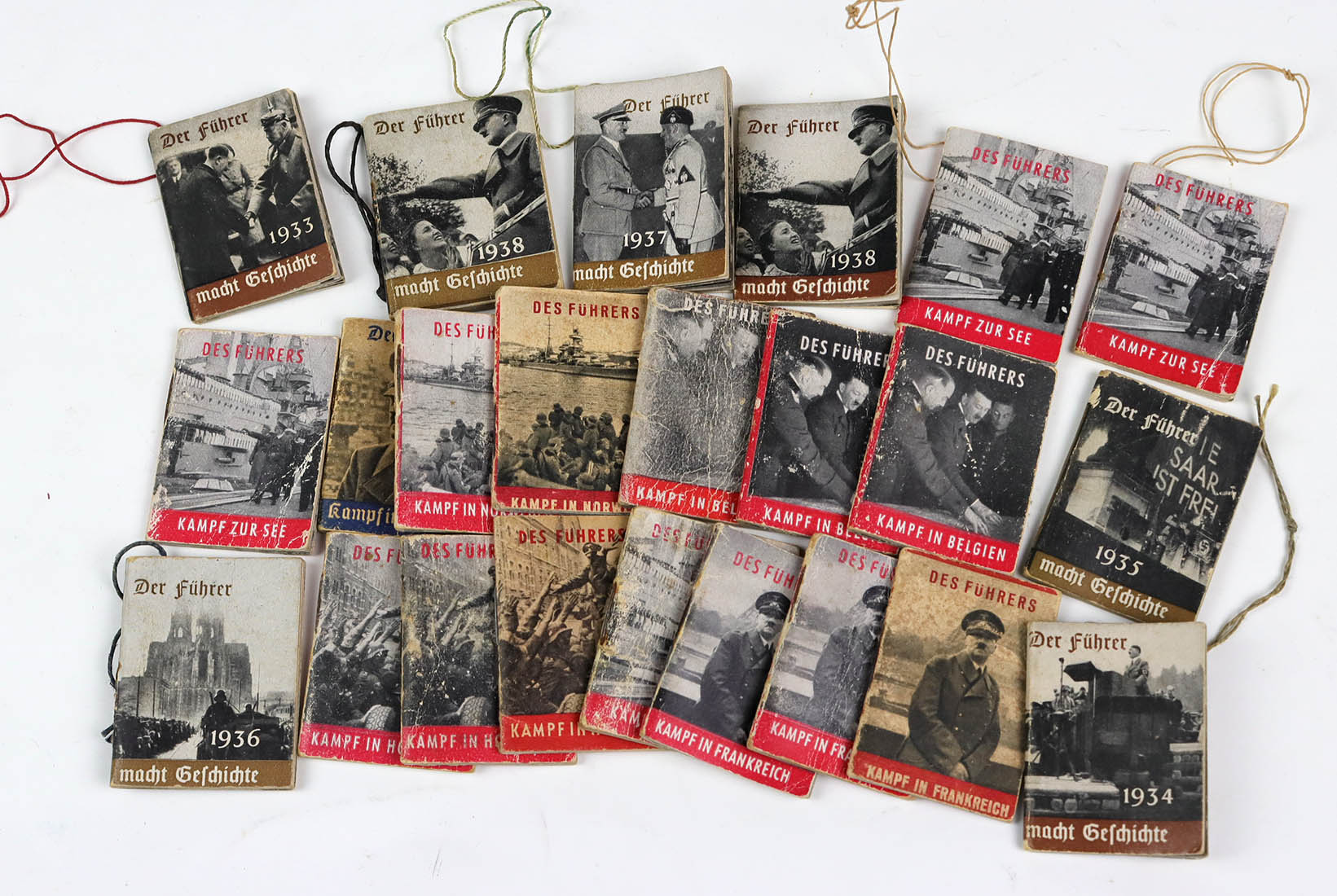
These tiny books were sold to raise funds to support various charities. In Nazi Germany the Winterhilfswerk (Winter Charity Campaign, or WHW) collection campaigns took place each Winter and raised a great deal of money for charity such as the German Red Cross. This series of booklets were published from 1937 -1941 by Heinrich Hoffmann, Hitler’s official photographer. There were 26 different books in total to collect. The booklets had a string, so one could wear them from a lapel pin, to show that you had made a donation. The following week, when there was a new series of badges & tokens to collect, the booklets could then be hung elsewhere in the home, such as from the Christmas Tree along with other Reich approved ornaments.

Collectible Souvenir Photos
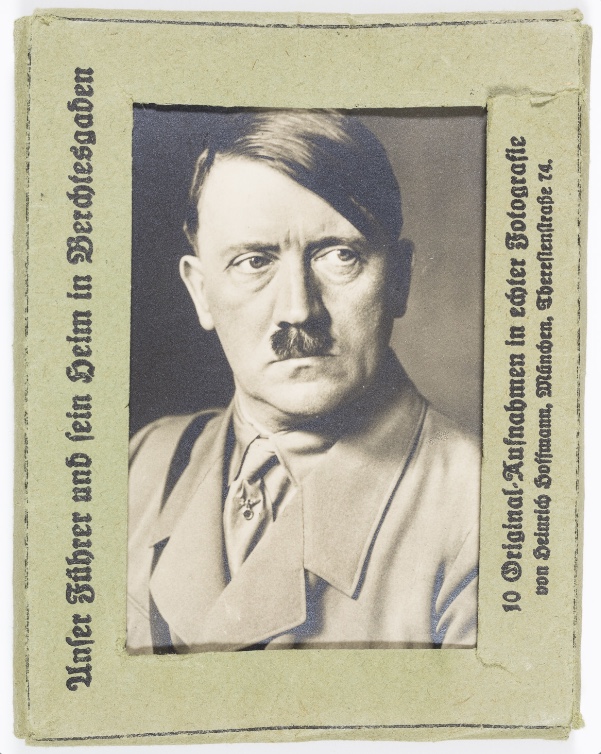
These ten souvenir photographs (2 1/2″ x 3 1/2″) comprised the set titled “Unser Führer uns sein Heim in Berchtesgaden” (“Our Führer and His Home in Berchtesgaden”). These were published by the studio of Hitler’s personal photographer Heinrich Hoffmann in Munich. The set includes an interior and exterior view of “Haus Wachenfeld”, the small chalet which was converted into the site of Hitler’s mountain estate, the Berghof, through massive renovations which took place on the site in 1936. The remaining eight photos consist of views of Hitler, primarily candid views including an image of the dictator standing before Haus Wachenfeld with Rudolf Hess, three images of Hitler with children at Berchtesgaden (two showing him with Bernile Nienau, known as “the Führer’s child”, who was later discovered to be one-quarter Jewish), with his dog and feeding deer in the property. Each photo is captioned, numbered, and marked with Hoffman’s address on the reverse. The set was secured within a small green paperboard case, bearing the printed title of the set and bearing Hoffmann’s publishing line.

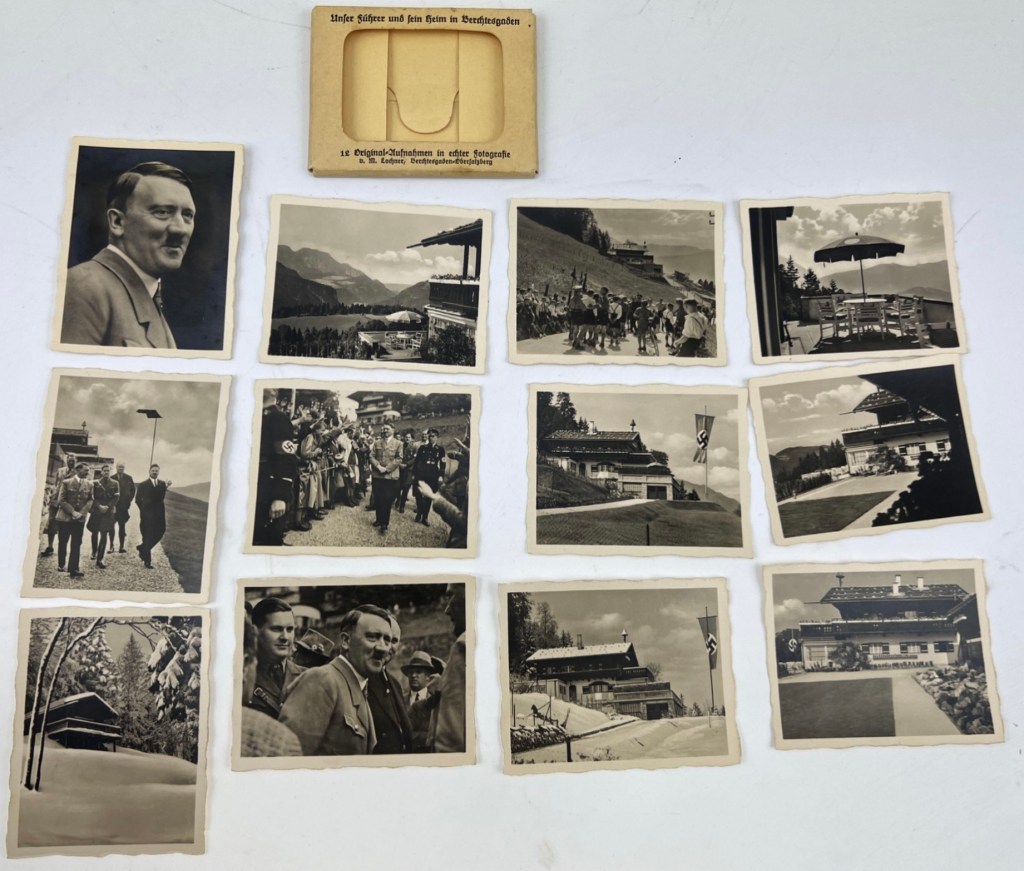
I also recently discovered another version of this set that featured 12 more scenes titled “Unser Führer uns sein Heim in Berchtesgaden” (“Our Führer and His Home in Berchtesgaden”). These photographs seemed much more rare than the 10 that were featured in the original set, and I discovered that they were all taken by a local photographer based in Berchtesgaden named Michael Lochner. Many other professional photographers, such as Ernst Baumann and Ludwig Amonn, produced and sold souvenir postcards showing Hitler on the Obersalzburg, as well as scenes from other tourist destinations around Berchtesgaden. Lochner sold his photography business to his brother after the war to strictly focus on his painting career.

Wall and Desk Calendars
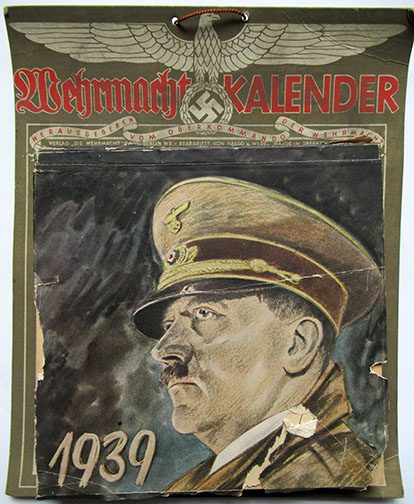
Both wall and desk calendars were produced between the years 1939 and 1944. The desk calendar pages were printed on heavy card stock that were to be torn off once a week and would also function as postcards. A special calendar was also published by the Deutsches Verlagshaus in Dresden in the year Hitler celebrated his 50th birthday. After the end of each week a page would be torn off and another photo of Adolf Hitler would decorate the room for that week – so 52 unique photos were featured of a place or event directly connected to him.



NSDAP 1932 Election Pamphlets
In February 1932 Adolf Hitler ran against Paul von Hindenburg in the presidential campaign. Joseph Goebbel’s propaganda campaign presented Hitler as a new, dynamic and modern leader for Germany. To emphasise this point, the Nazis pioneered new campaigning tactics, such as direct mailing and transporting Hitler across the country by airplane, allowing him to perform at several rallies in a single day. Hitler lost the election with 36.8% of the vote to Hindenburg’s 53%, but despite losing, people now viewed Hitler as a credible politician. Following the Reichstag election in July 1932, the Nazis became the largest party with 230 seats and 37.3% of the vote. The following pamphlets were distributed over the course of the presidential campaign. There were 12 from the series of early Nazi propaganda publications called Kampfschrift der Reichspropaganda-Leitung der NSDAP.

‘Adolf Hitler, Der Deutsche Arbeiter und Frontsoldat’ (German Worker and Front Soldier) Kampfschrift Number 9 was a 32 page pamphlet issued by the NSDAP during the first round of the 1932 presidential campaign that was held on 13 March. It was written by Dagobert Dürr and presents Hitler as a model citizen in every regard.
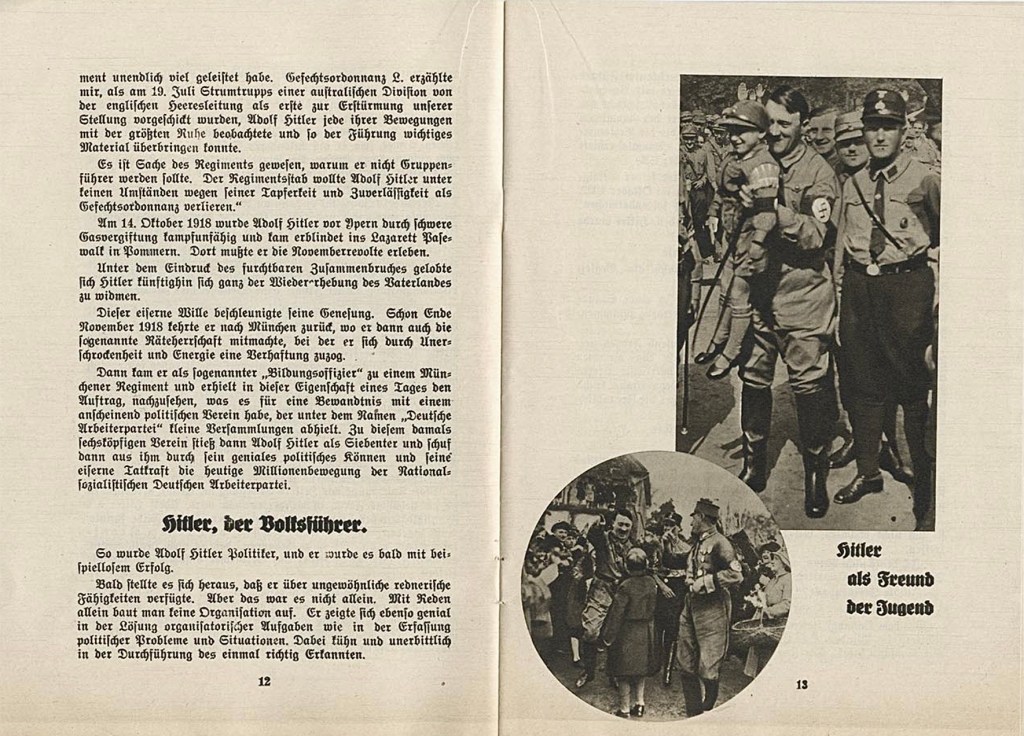
“He who has once looked in Hitler’s eyes will never forget it. His eyes resemble the famous eyes of Frederick the Great. His expression can be hard as steel one moment, but radiate goodness the next. When he reviews his S.A. men, his gaze seems to penetrate to the deepest depths of each.”
– Dagobert Dürr ‘Adolf Hitler, Der Deutsche Arbeiter und Frontsoldat’

‘Tatsachen und Lügen um Hitler‘ was a late March or early April 1932 pamphlet publication that translates to ‘Facts and Lies About Hitler’. Released shortly before the second round of the Reich Presidential election on 10 April 1932. It presents Hitler as a self-made man who has been slandered by his opponents, and who is the only person capable of saving Germany. It was aimed at the electorate in general rather than a specific group.
“Now he is being slandered in word and image, labeled a tyrant and an actor, a glutton and a spendthrift, just because his fighting goal is: Death to Marxism, so that Germany lives! We have remained silent about these pathetic lies for years. How today he’s splurging and feasting, drinking champagne and ordering place settings for 20M. And the Red bigwigs and creatures probably think about how they do it. Unless here too is revealed how the man lives who, in just a few weeks, donated half a million marks to the National Socialist Party through his speeches: soup, vegetable platter and a bottle of mineral water, no alcohol, no meat, no cigar and no cigarette. Anyone who doubts this should ask the hoteliers where Adolf Hitler stayed on his travels and who are well known to the Jewish and Social Democratic sleazebags. Spartan simplicity characterizes Adolf Hitler’s life.”
– Rudolf Hess ‘Tatsachen und Lügen um Hitler‘
‘Adolf Hitler Spricht’ Card Set
This set of photographs features six poses from a 1927 portrait session taken in Heinrich Hoffmann’s studio along with quotes from several of Hitler’s speech’s. What is most interesting about this set is that it is widely claimed that Hitler took these photographs in a private session with Hoffmann strictly to study his facial expressions and hand gestures and wanted them destroyed immediately after viewing them. Yet I continually find these 30+ portraits featured on dozens of propaganda materials from postcards to magazines and even on a series of picture records that were distributed of his speeches.


This is believed to be the very first picture disc ever produced in history. In 1934 Adolf Hitler released a series of Nazi speeches on a flat shellac disc, which featured a picture of him superimposed over a large crowd. This one was titled “Adolf Hitler Speaks To Berlin” and also featured an address by Johann Heinrich “Hans” Hinkel, commissioner of the Reich Chamber of Culture that had complete control over the cultural life in Germany in order to promote Aryan art consistent with Nazi ideals.
Nazi Photo Flip Books
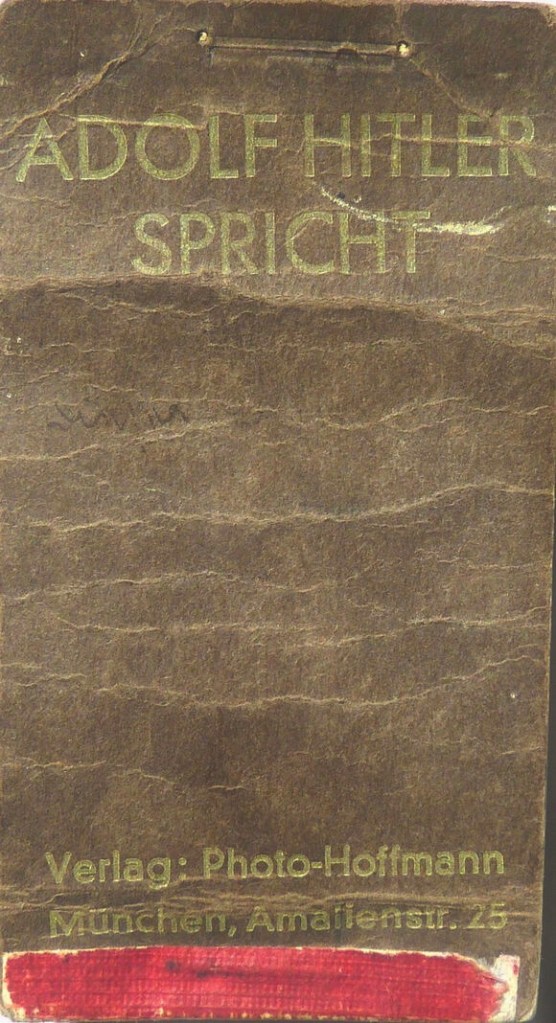
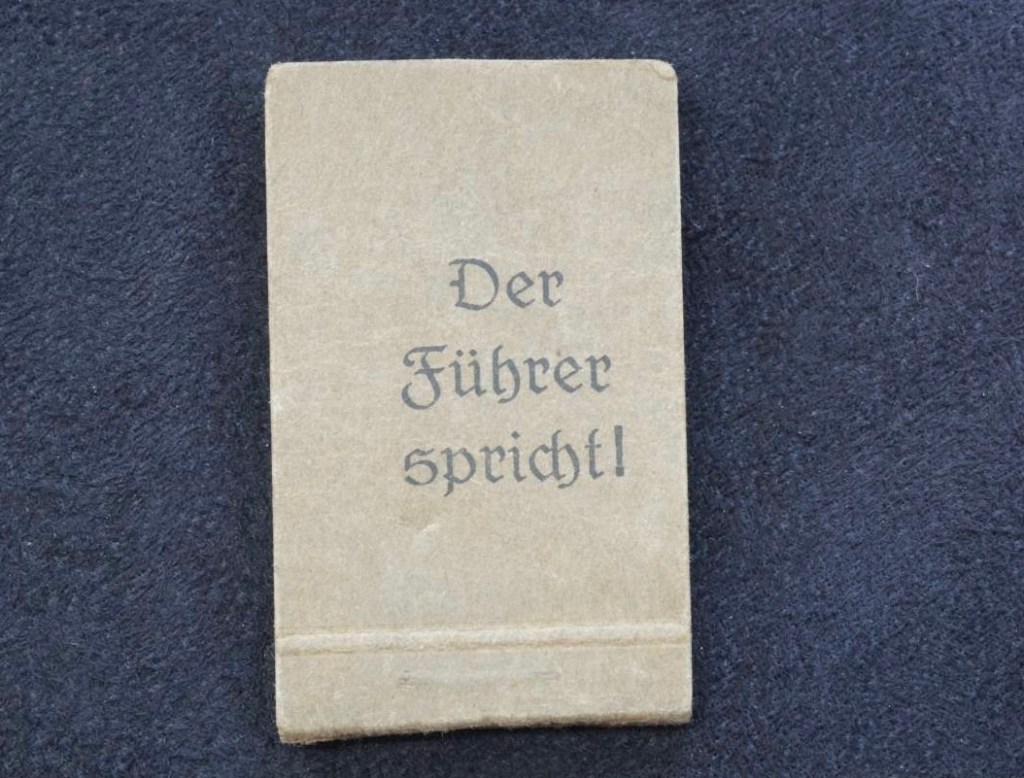
Hoffmann produced a photo flip book in 1929, flip the pages with your thumb and it looks like Hitler is moving as he gives his speech. This also showed how propaganda ideas can fail. It shows a wildly gesticulating Hitler addressing the Sturmabteilung (SA), the party’s paramilitary branch, on the Luitpoldhain at the 1929 Nazi Party Rally in Nuremberg. In the background are standards with large swastikas, a few members of the SA, and a hedge. At that time the Luitpoldhain was still a park, not the cleared open arena that it would become in 1933. The uniformed SA members had to position themselves amid hedges, a fountain, and parkland trees – hardly the perfect setting for a grand parade and speech. This was the last flip book that Photo Hoffmann produced. Even other sources only made two more such flip books: Erich Bethe sold one named “Greeting from the Führer,” and the Hamburg publishers Wahler und Sohn published one called “The Führer Speaks” shown below.




Nazi Stereoscopic Photobooks
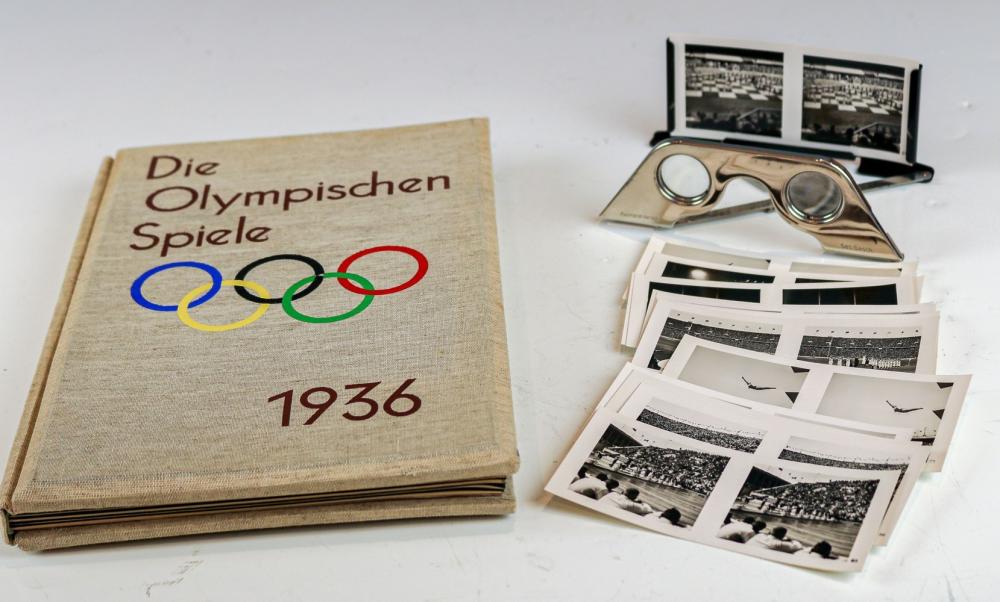
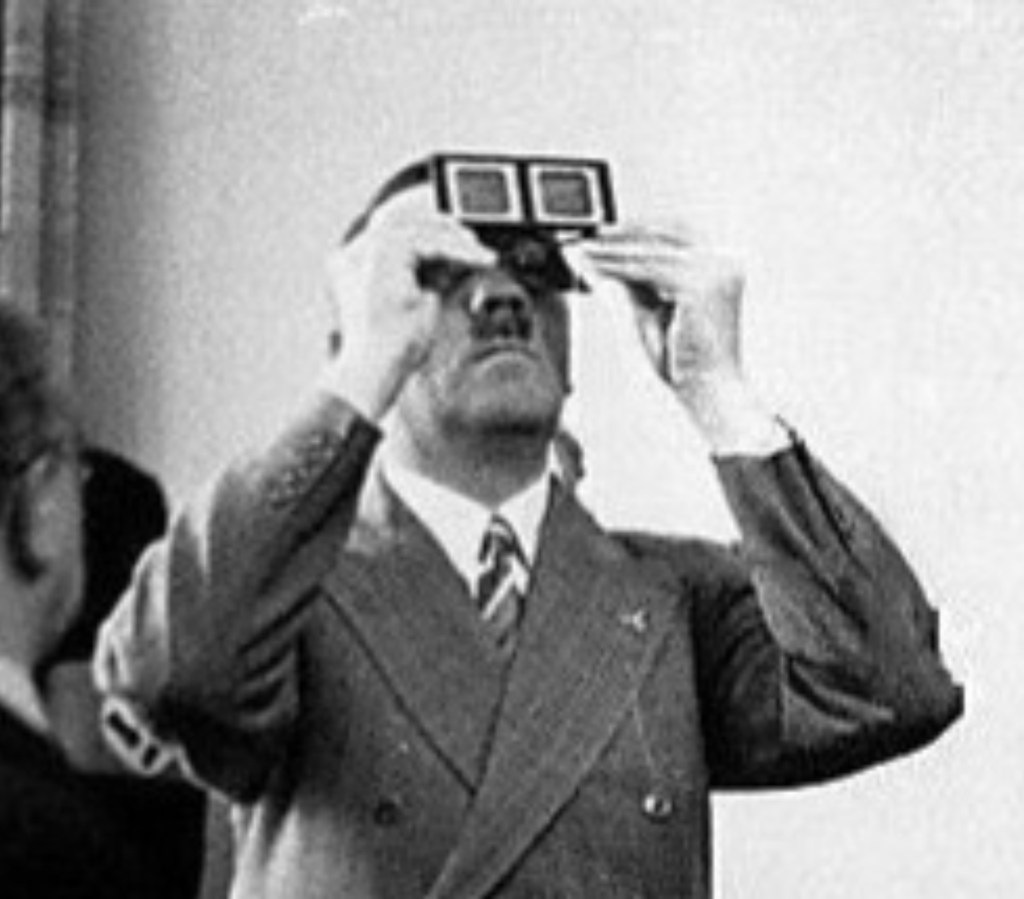
Stereoscopic photography is a distinctive visual medium for viewing photos in 3D and has been around since the 19th century. Raumbild Verlag in Munich was a publisher that specialized in stereoscopic publications. These books were very popular in Germany before World War II, when Raumbild mainly produced books for tourists and erotic publications. As National Socialism in Germany grew, the publisher switched its focus to political propaganda. Raumbild worked with film maker Leni Riefenstahl on a stereoscopic photo-book about the 1936 Olympic Games in Berlin. Raumbild also produced several books in partnership with Hitler’s official photographer Heinrich Hoffmann.




 Heinrich Hoffmann Photo Gallery